
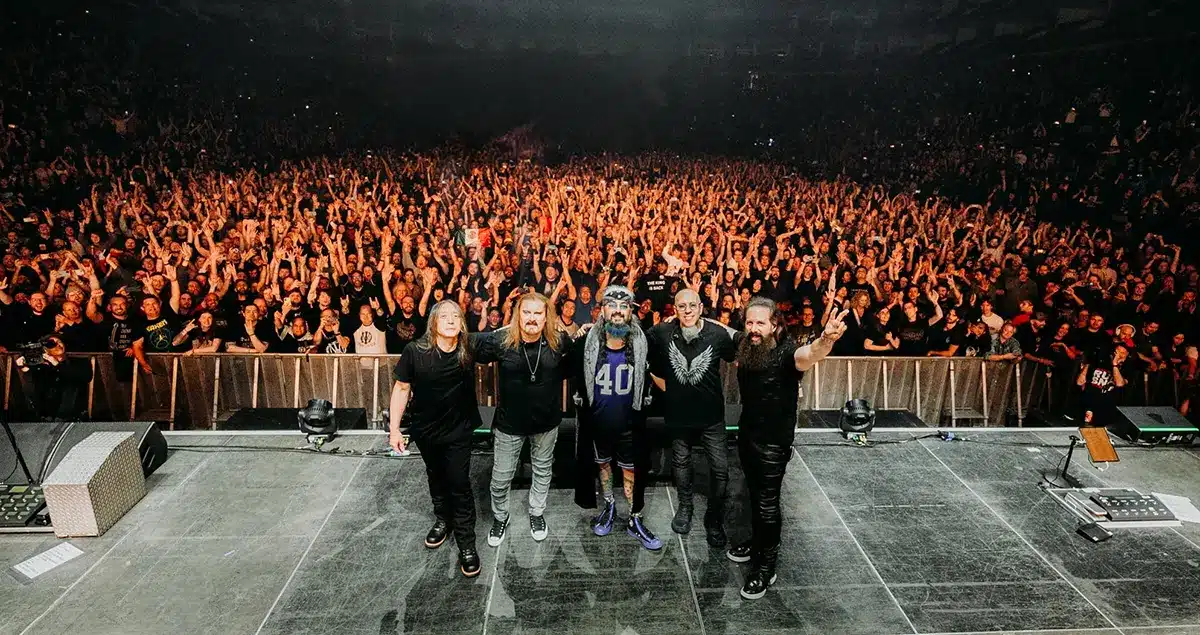
Dream Theater: Technical Mastery and the Modernization of Progressive Metal
Quick Facts
Founded: 1985 (as Majesty)
Origin: Boston, Massachusetts, USA
Genres: Progressive Metal
Classic Line-Up (Long-Term Core): James LaBrie, John Petrucci, John Myung, Jordan Rudess, Mike Portnoy (later: Mike Mangini)
Years Active: 1985–present
Origin Story – Berklee Foundations
Dream Theater was formed in 1985 by guitarist John Petrucci, bassist John Myung, and drummer Mike Portnoy while studying at Berklee College of Music.
The band’s early direction combined the structural ambition of progressive rock acts like Rush and Yes with the technical aggression of 1980s heavy metal.
Initially named Majesty, they were forced to change their name before releasing their debut album. The early lineup stabilized with vocalist James LaBrie joining in 1991.
Unlike many metal bands that evolved from local club scenes, Dream Theater’s foundation was technical discipline. The members approached composition with formal musical training.
Their early work demonstrated ambition but lacked mainstream breakthrough.
That changed in the early 1990s.
The Turning Point – Images and Words (1992)
Released in 1992, Images and Words marked the band’s commercial and artistic breakthrough.
The album balanced complexity with melody. Rather than overwhelming listeners with constant technical display, it integrated extended instrumental sections within structured songs.
Key characteristics included:
Shifting time signatures
Extended instrumental solos
Synthesizer-guitar interplay
Clear vocal hooks
The single “Pull Me Under” received radio airplay, introducing progressive metal to a broader audience.
The album established Dream Theater as leaders of a developing subgenre.
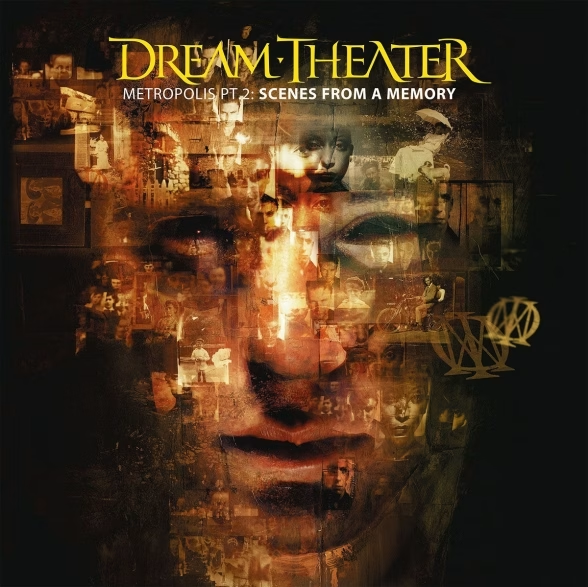
Milestone Album – Metropolis Pt. 2: Scenes from a Memory (1999)
While Images and Words introduced them to mainstream audiences, Metropolis Pt. 2: Scenes from a Memory became their defining artistic statement.
The album functions as a continuous concept narrative built around themes of memory, identity, and reincarnation.
Structurally, it features:
Recurring musical motifs
Thematic continuity
Multi-section compositions
Instrumental precision
The band integrated heavy riffs with piano passages and orchestral textures.
Rather than writing isolated tracks, they structured the album as a unified work.
It remains one of the most cited progressive metal albums of all time.
Signature Song – Pull Me Under
“Pull Me Under” represents the band’s ability to balance technical ambition with accessibility.
The song opens with layered clean guitar passages before shifting into heavier sections. Time signature changes are present but subtle enough to avoid disrupting flow.
The structure includes:
Gradual dynamic build
Instrumental bridge
Abrupt ending
James LaBrie’s vocal delivery remains melodic rather than aggressive, distinguishing Dream Theater from thrash or extreme metal acts.
The track introduced progressive metal into mainstream rock radio rotation.
Instrumental Identity
Dream Theater’s structure relies heavily on instrumental interplay.
John Petrucci’s guitar work combines technical precision with melodic phrasing.
John Myung’s bass lines often mirror complex rhythmic patterns rather than simple root notes.
Mike Portnoy (and later Mike Mangini) emphasized polyrhythms and double-bass control.
Jordan Rudess integrated advanced keyboard textures and orchestration.
The band’s compositions often exceed traditional radio length, but the arrangements remain structured rather than improvised.
Unlike earlier progressive bands that relied on studio experimentation, Dream Theater emphasizes performance precision.
Line-Up Changes and Continuity
In 2010, founding drummer Mike Portnoy departed after decades as a central creative figure.
He was replaced by Mike Mangini, whose technical skill maintained rhythmic complexity.
In 2023, Portnoy rejoined the band, restoring the classic rhythm dynamic.
Despite lineup shifts, John Petrucci and John Myung have remained continuous members since formation.
The band’s longevity is built on technical consistency rather than stylistic reinvention.
Members (Core Era)
James LaBrie – Vocals
John Petrucci – Guitar
John Myung – Bass
Jordan Rudess – Keyboards
Mike Portnoy – Drums (1985–2010, 2023–present)
Mike Mangini – Drums (2010–2023)
Selected Studio Discography Highlights
When Dream and Day Unite (1989)
Images and Words (1992)
Awake (1994)
Metropolis Pt. 2: Scenes from a Memory (1999)
Six Degrees of Inner Turbulence (2002)
Octavarium (2005)
Black Clouds & Silver Linings (2009)
A Dramatic Turn of Events (2011)
Distance Over Time (2019)
Structural Contribution to Metal
Dream Theater influenced modern metal in several ways:
Technical Standardization
High-level musicianship became expected within progressive metal circles.Concept Album Revival
Narrative-driven albums regained prominence in heavy music.Integration of Virtuosity and Structure
Technical display served composition rather than replacing it.Bridging Progressive Rock and Modern Metal
They formalized progressive metal as a distinct subgenre.
Unlike thrash bands defined by speed or traditional metal acts defined by riff repetition, Dream Theater emphasized controlled complexity.
Legacy
Dream Theater occupies a central position within progressive metal.
They did not aim for mainstream dominance but established long-term credibility through technical consistency.
Their catalog demonstrates that complexity can function within structured songwriting.
They did not simplify metal.
They refined it.