
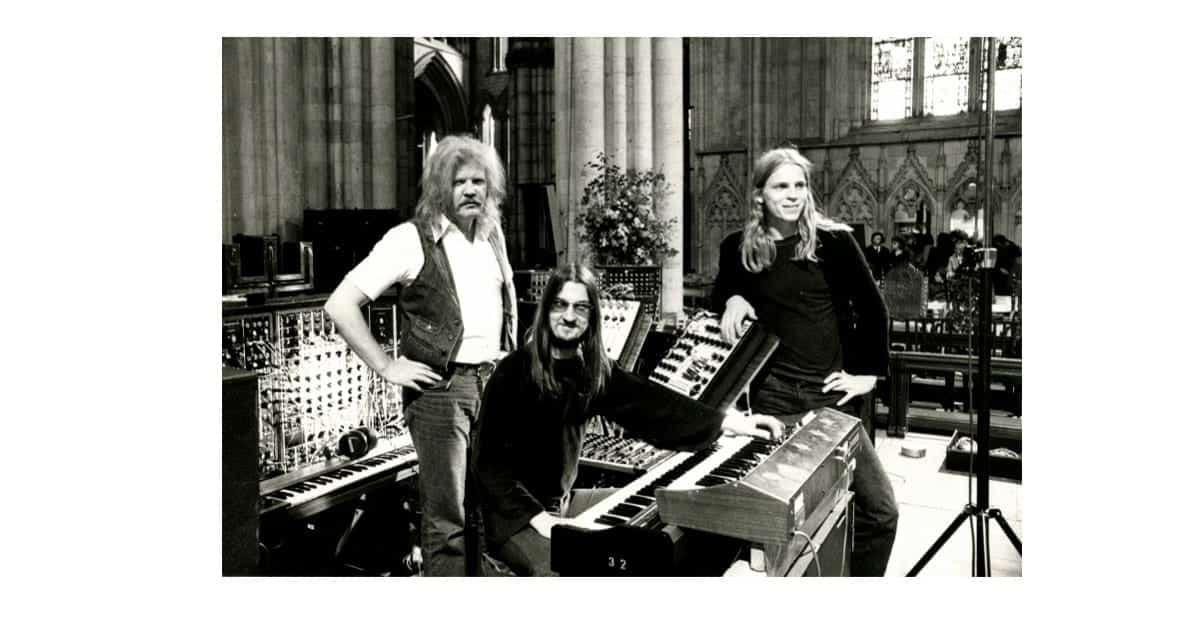
Tangerine Dream: When Music Stopped Moving Forward
Tangerine Dream is often discussed in terms of electronics, synthesizers, or the Berlin School. Those labels describe how the music was made, but they completely miss why it mattered. Tangerine Dream didn’t push music forward. They did something far stranger:
They removed the idea of forward motion altogether.
In their world, music doesn’t build toward a climax. It doesn’t resolve. It doesn’t even “progress” in the traditional sense. It simply exists, unfolding in real time, indifferent to expectation.
That single decision quietly changed how listening itself could work.
Time Without Narrative
Most music treats time as a path. You begin, you travel, you arrive. Tangerine Dream rejected this model entirely. Their compositions don’t tell stories. They establish temporal conditions.
Instead of asking “what happens next?”, the listener begins asking “how long has this been happening?” Time stops being directional and becomes textural.
This is crucial. Once narrative disappears, attention shifts. You stop tracking events and start noticing duration.
Sequencing as Stability, Not Drive
The repeating sequences that define Tangerine Dream’s sound are often misunderstood as momentum engines. In reality, they do the opposite. They stabilize time.
Repetition here isn’t propulsion—it’s anchoring. By locking the music into cyclical patterns, Tangerine Dream creates a sense of permanence. Nothing is rushing toward resolution. Nothing is collapsing.
The listener relaxes not because the music is gentle, but because it is predictably endless.
Atmosphere Over Emotion
Tangerine Dream rarely communicates emotion directly. There is no plea, no confession, no dramatic arc. What they offer instead is environment.
You don’t feel sadness or joy. You feel temperature, distance, scale. The music behaves like weather—present, immersive, unconcerned with interpretation.
This neutrality is powerful. It allows the listener to project internal states without interference. The music doesn’t tell you how to feel. It gives you space to notice that you are feeling.
Soundtrack Logic Without Images
Long before ambient and cinematic music became common language, Tangerine Dream understood something fundamental: sound doesn’t need images to feel visual.
Their music suggests movement without destination, space without location, tension without conflict. It feels like a soundtrack to something that never quite begins.
This “pre-narrative” quality made their work uniquely adaptable—not because it illustrated scenes, but because it withheld definition.
Listening as Suspension
Tangerine Dream trains the listener to suspend judgment. There is no payoff to wait for. No hook to recognize. No message to decode.
The reward is subtle:
You stop measuring the music.
And in doing so, you stop measuring time.
This suspension is deeply rare in popular music, which usually depends on anticipation. Tangerine Dream removed anticipation entirely—and found depth in its absence.
Why It Still Works
In a culture obsessed with acceleration, Tangerine Dream feels almost radical. Their music refuses urgency. It doesn’t react to the listener’s impatience. It outlasts it.
That endurance is why their work still resonates. Not as nostalgia, not as genre history—but as a reminder that not everything needs direction to be meaningful.
The Core Insight
Tangerine Dream revealed that music doesn’t need to go somewhere to hold attention. It can simply hold time steady.
By removing narrative, climax, and resolution, they transformed listening into an act of presence rather than pursuit.
Final Thought
Tangerine Dream matters because they challenged the most basic assumption in music: that time must move forward. They showed that stillness, when carefully designed, can be immersive rather than empty.
They didn’t slow music down.
They taught it how to stay.