

King Crimson: Experimentation, Discipline, and the Foundations of Progressive Rock
Quick Facts
Founded: 1968
Origin: London, England
Genres: Progressive Rock, Art Rock, Experimental Rock
Founding Line-Up (1969): Robert Fripp, Greg Lake, Ian McDonald, Michael Giles, Peter Sinfield
Years Active: 1968–present (with multiple lineup transformations)
Origin Story – Structured Experimentation
King Crimson was formed in 1968 by guitarist Robert Fripp and drummer Michael Giles, soon joined by bassist and vocalist Greg Lake, multi-instrumentalist Ian McDonald, and lyricist Peter Sinfield.
From the outset, the band pursued structural ambition rather than conventional rock format. Their goal was not volume or speed but compositional expansion.
Unlike blues-based hard rock acts emerging at the same time, King Crimson incorporated:
Jazz harmony
Symphonic arrangement
Mellotron textures
Abstract lyricism
Their first album would define progressive rock’s early blueprint.
The Turning Point – In the Court of the Crimson King (1969)
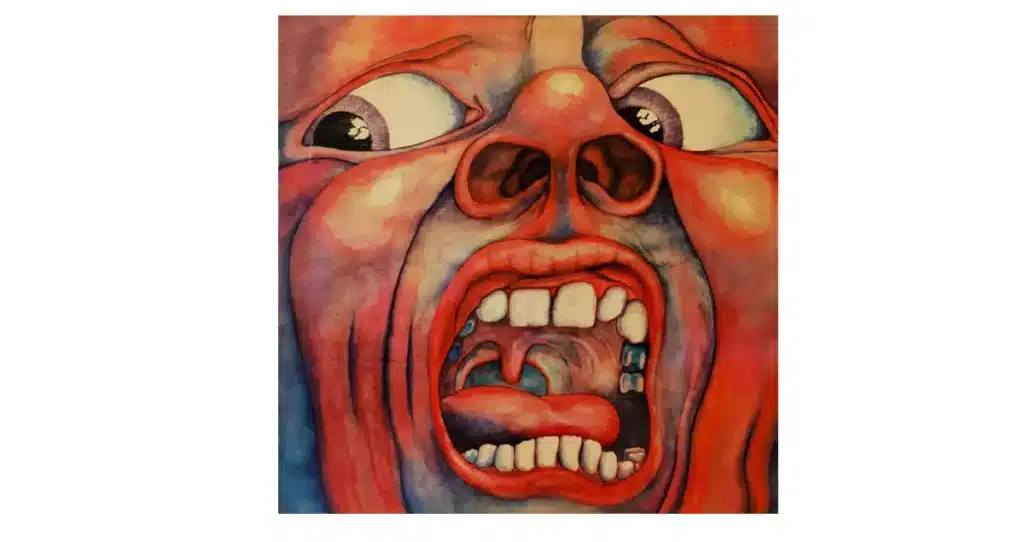
Released in 1969, In the Court of the Crimson King is widely regarded as one of the foundational progressive rock albums.
The opening track, “21st Century Schizoid Man,” combined distorted vocals, complex time signatures, and jazz-influenced instrumental sections.
The album balanced aggression and atmosphere:
Heavy riff-driven passages
Mellotron-based orchestral textures
Extended instrumental interludes
Rather than following verse-chorus patterns, the compositions evolved through movement.
The record established King Crimson as early progressive leaders.
However, internal cohesion was short-lived.
Instability as Identity
Shortly after their debut, key members departed. Robert Fripp became the consistent figure across multiple lineups.
Unlike many bands that seek stability, King Crimson embraced transformation.
The early 1970s saw albums such as Lizard (1970), Islands (1971), and Larks’ Tongues in Aspic (1973), each featuring new personnel and structural direction.
The 1973–1974 lineup with John Wetton and Bill Bruford emphasized heavier, rhythmically complex material.
King Crimson’s identity became less about fixed membership and more about disciplined experimentation.
Milestone Album – Red (1974)
Red is frequently cited as King Crimson’s most influential release.
The album stripped away some symphonic elements in favor of concentrated, riff-driven intensity.
Key characteristics include:
Angular guitar structures
Polyrhythmic drumming
Dense harmonic layering
The title track, “Red,” is built around a repetitive but complex riff structure.
Unlike more melodic progressive acts, Red emphasized tension and precision.
The album influenced later progressive metal and experimental rock movements.
Shortly after its release, the band disbanded.
Signature Song – 21st Century Schizoid Man
“21st Century Schizoid Man” remains King Crimson’s most recognized composition.
The structure includes:
Aggressive opening riff
Instrumental jazz-fusion middle section
Reprise with intensified tempo
The distorted vocal effect was unconventional at the time, creating a confrontational tone.
The song demonstrated that progressive rock could incorporate heaviness and complexity simultaneously.
Its influence extends into metal and avant-garde rock circles.
Reinvention in the 1980s
King Crimson reformed in 1981 with a new lineup including Adrian Belew and Tony Levin.
Albums such as Discipline (1981) introduced:
Interlocking guitar patterns
Minimalist repetition
Electronic textures
This era emphasized rhythmic precision over orchestral expansion.
Rather than revisiting earlier progressive formulas, the band adopted contemporary influences.
King Crimson continued evolving across decades, with configurations including double-trio and multiple-drummer lineups.
Members (Notable Eras)
Robert Fripp – Guitar (constant member)
Greg Lake – Bass, Vocals (early era)
Ian McDonald – Multi-instrumentalist
John Wetton – Bass, Vocals (1970s era)
Bill Bruford – Drums
Adrian Belew – Guitar, Vocals
Tony Levin – Bass
Robert Fripp remains the conceptual anchor across all phases.
Selected Studio Discography Highlights
In the Court of the Crimson King (1969)
Lizard (1970)
Larks’ Tongues in Aspic (1973)
Red (1974)
Discipline (1981)
THRAK (1995)
The Power to Believe (2003)
Structural Contribution to Progressive Rock
King Crimson influenced rock through:
Foundational Progressive Blueprint
Early use of Mellotron and extended composition.Integration of Jazz and Avant-Garde Elements
Complex harmonic structures entered rock context.Lineup Fluidity Model
Reinvention became structural, not accidental.Rhythmic Innovation
Polyrhythms and interlocking guitar patterns expanded rock’s technical vocabulary.
Unlike bands that maintained a consistent sonic signature, King Crimson prioritized conceptual evolution.
Legacy
King Crimson occupies a distinct role in rock history.
They were not commercially dominant, but they were structurally influential.
Their approach demonstrated that rock could function as a vehicle for experimentation without abandoning discipline.
They did not stabilize progressive rock.
They destabilized it — repeatedly — and reassembled it.