
Genesis: Narrative Ambition, Structural Evolution, and the Shift from Progressive Rock to Pop
Quick Facts
Founded: 1967
Origin: Godalming, Surrey, England
Genres: Progressive Rock, Art Rock, Pop Rock
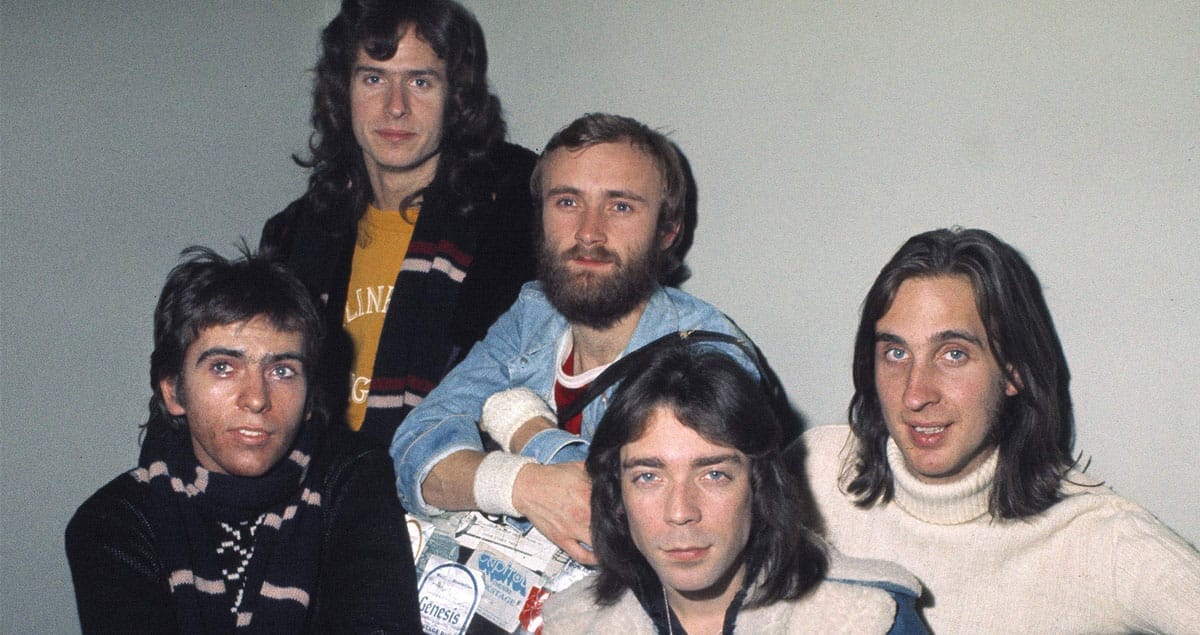
Classic Progressive Era Line-Up: Peter Gabriel, Tony Banks, Mike Rutherford, Steve Hackett, Phil Collins
Later Pop Era Core: Phil Collins, Tony Banks, Mike Rutherford
Years Active: 1967–2022
Origin Story – School Formation and Early Direction
Genesis was formed in 1967 by students at Charterhouse School. The founding members included Peter Gabriel, Tony Banks, Mike Rutherford, Anthony Phillips, and Chris Stewart.
Their earliest recordings reflected baroque pop influences rather than the expansive progressive style they later became known for. It was not until the early 1970s that Genesis developed a more distinct identity.
The addition of drummer Phil Collins in 1970 strengthened rhythmic flexibility. Guitarist Steve Hackett soon joined, completing what is often considered the classic progressive lineup.
With this configuration, Genesis moved decisively toward long-form composition and theatrical presentation.
The Turning Point – Nursery Cryme and Foxtrot
Albums such as Nursery Cryme (1971) and Foxtrot (1972) marked a shift toward complex arrangements and narrative-driven songwriting.
Peter Gabriel’s stage presence became increasingly theatrical. He used costumes and character voices to enhance live performances. The band embraced elaborate compositions featuring:
Extended instrumental passages
Shifting time signatures
Story-based lyrics
“Watcher of the Skies” and “Supper’s Ready” demonstrated structural ambition comparable to other progressive leaders of the era.
Genesis positioned themselves among the central acts of British progressive rock.
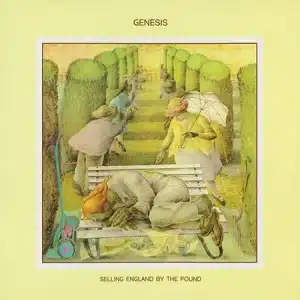
Milestone Album – Selling England by the Pound (1973)
Selling England by the Pound is widely regarded as the band’s progressive peak.
The album combined English cultural references with layered instrumentation. Tony Banks’ keyboard work provided harmonic depth, while Hackett’s guitar introduced sustained melodic phrasing.
Key characteristics include:
Multi-section compositions
Orchestral-style keyboard textures
Detailed lyrical imagery
Tracks such as “Firth of Fifth” showcased extended instrumental introductions and structured guitar solos.
The album solidified Genesis as a technically proficient and conceptually ambitious band.
Signature Song – Supper’s Ready
“Supper’s Ready,” from Foxtrot, is a multi-part composition spanning over 20 minutes.
The song moves through distinct sections with varying tempos and tonal centers. Peter Gabriel’s lyrics blend surreal imagery with allegorical storytelling.
The composition reflects several progressive principles:
Thematic recurrence
Instrumental development
Narrative progression
Rather than focusing on repetition, the piece emphasizes movement.
It remains a defining example of early 1970s progressive rock structure.
Transition – Peter Gabriel’s Departure
In 1975, Peter Gabriel left the band.
Rather than recruiting an external vocalist, drummer Phil Collins assumed lead vocal duties while continuing to contribute rhythmically.
This shift altered the band’s trajectory.
While retaining progressive elements on albums such as A Trick of the Tail (1976), Genesis gradually streamlined their songwriting.
Steve Hackett departed in 1977, further narrowing the lineup.
The trio of Collins, Banks, and Rutherford became the long-term core.
Pop-Oriented Reinvention – 1980s Era
During the 1980s, Genesis adopted shorter song formats and electronic textures.
Albums such as Duke (1980), Invisible Touch (1986), and We Can’t Dance (1991) emphasized:
Concise arrangements
Strong choruses
Synthesizer-driven production
“Invisible Touch” became their biggest commercial success, reaching number one in the United States.
The band transitioned from progressive innovators to mainstream pop-rock leaders.
This shift expanded their audience but divided longtime progressive listeners.
Members (Classic Progressive Era)
Peter Gabriel – Vocals
Tony Banks – Keyboards
Mike Rutherford – Bass/Guitar
Steve Hackett – Guitar
Phil Collins – Drums (later Vocals)
Tony Banks and Mike Rutherford remained constant members throughout most of the band’s history.
Selected Studio Discography Highlights
Trespass (1970)
Nursery Cryme (1971)
Foxtrot (1972)
Selling England by the Pound (1973)
The Lamb Lies Down on Broadway (1974)
A Trick of the Tail (1976)
Duke (1980)
Invisible Touch (1986)
We Can’t Dance (1991)
Structural Contribution to Rock
Genesis influenced rock through:
Theatrical Storytelling
Early albums integrated narrative structure with live performance elements.Keyboard-Led Arrangement
Tony Banks’ harmonic control shaped the band’s sonic density.Successful Genre Transition
They demonstrated that a progressive band could pivot toward mainstream pop without dissolving.Album-Level Cohesion
Conceptual continuity characterized their 1970s output.
Unlike bands that maintained stylistic rigidity, Genesis adapted across eras.
Legacy
Genesis occupies a dual legacy.
In the 1970s, they were progressive innovators with narrative ambition and structural complexity. In the 1980s, they became global pop-rock figures.
Few bands successfully bridged those two identities.
Their impact spans progressive rock enthusiasts and mainstream audiences alike.
Genesis did not remain fixed.
They evolved — significantly — and sustained relevance across decades.