

AC/DC: Simplicity, Consistency, and the Reinforcement of Hard Rock
Quick Facts
Founded: 1973
Origin: Sydney, Australia
Genres: Hard Rock, Rock and Roll
Classic Line-Ups:
Bon Scott Era – Bon Scott, Angus Young, Malcolm Young, Cliff Williams, Phil Rudd
Brian Johnson Era – Brian Johnson, Angus Young, Malcolm Young, Cliff Williams, Phil Rudd
Years Active: 1973–present
Origin Story – The Young Brothers and a Clear Direction
AC/DC was formed in 1973 by brothers Malcolm and Angus Young after emigrating from Scotland to Australia. Unlike many British contemporaries experimenting with progressive structures or theatrical presentation, AC/DC focused on direct, riff-based rock.
Malcolm Young served as the rhythmic foundation of the band. His tightly controlled downstroke guitar patterns defined their structural identity. Angus Young handled lead guitar duties and developed a distinct stage presence, performing in a school uniform — a visual contrast to the heavier, darker aesthetics of other hard rock bands.
The early lineup included vocalist Bon Scott, whose gritty vocal tone and direct lyrical style shaped the band’s personality. AC/DC’s early Australian releases emphasized straightforward blues-based rock with high energy and minimal ornamentation.
The band relocated to the United Kingdom in 1976, entering a competitive hard rock environment that included Led Zeppelin, Deep Purple, and the emerging punk movement.
Their strategy was not innovation through complexity.
It was refinement through repetition.
The Turning Point – Highway to Hell (1979)
After several albums that built a strong reputation in Europe and Australia, AC/DC achieved international breakthrough with Highway to Hell in 1979.
Produced by Robert John “Mutt” Lange, the album polished their sound without diluting its core identity. The riffs remained simple and forceful. The rhythm section maintained tight, consistent tempo control.
The title track became their defining anthem. It combined a memorable opening riff with Bon Scott’s distinctive vocal delivery.
Highway to Hell established AC/DC as global contenders.
Months later, Bon Scott died in February 1980.
The band faced a critical decision: disband or continue.
Continuation and Reinvention – Back in Black (1980)
Rather than dissolving, AC/DC recruited Brian Johnson as their new vocalist.
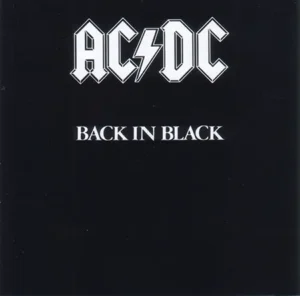
The album Back in Black, released in 1980, became both a tribute to Bon Scott and a commercial milestone.
It remains one of the best-selling albums in history.
Milestone Album – Back in Black (1980)
Back in Black refined the AC/DC formula:
-
Clean, powerful guitar tones
-
Clear rhythmic emphasis
-
Minimal harmonic complexity
-
Tight song structures
Tracks such as:
-
“Back in Black”
-
“You Shook Me All Night Long”
-
“Hells Bells”
demonstrated structural clarity.
The production emphasized separation between instruments. Malcolm Young’s rhythm guitar created a steady foundation, while Angus Young’s lead lines provided concise but effective solos.
The album avoided excessive layering. Its strength came from controlled restraint.
Rather than expanding into progressive territory, AC/DC doubled down on core principles.
The result was commercial dominance.
Signature Song – Back in Black
“Back in Black” is structured around one of hard rock’s most identifiable riffs.
The opening guitar phrase is sparse, allowing space between notes. The groove is mid-tempo, supported by Phil Rudd’s steady drumming and Cliff Williams’ consistent bass reinforcement.
Brian Johnson’s vocal tone contrasts with Bon Scott’s, yet maintains the band’s raw edge.
The song’s structure is economical:
-
Intro riff
-
Verse
-
Chorus
-
Short solo
-
Repetition
There are no complex transitions or extended instrumental passages.
Its effectiveness lies in rhythmic precision and clarity.
Structural Philosophy – Less as More
AC/DC’s long-term stability is tied to structural discipline.
They avoided dramatic stylistic shifts. Across decades, their albums retained similar tempo ranges, tonal structure, and arrangement principles.
Key characteristics include:
-
Minimal chord progressions
-
Prominent rhythm guitar
-
Direct lyrical themes
-
Controlled song length
While other bands pursued experimentation or conceptual albums, AC/DC maintained a focused identity.
This consistency became their advantage.
Line-Up Changes and Longevity
Malcolm Young remained the band’s rhythmic anchor until health issues forced his retirement. He passed away in 2017.
Phil Rudd and Cliff Williams experienced intermittent departures but returned during later touring cycles.
Angus Young remains the central figure, maintaining continuity in both sound and stage presence.
Unlike many long-running bands, AC/DC’s brand identity remained stable across lineup changes.
Members (Core Eras)
Angus Young – Lead Guitar
Malcolm Young – Rhythm Guitar
Bon Scott – Vocals (1974–1980)
Brian Johnson – Vocals (1980–present)
Cliff Williams – Bass
Phil Rudd – Drums
Selected Studio Discography Highlights
High Voltage (1975)
Dirty Deeds Done Dirt Cheap (1976)
Let There Be Rock (1977)
Highway to Hell (1979)
Back in Black (1980)
For Those About to Rock (We Salute You) (1981)
The Razor’s Edge (1990)
Black Ice (2008)
Power Up (2020)
Structural Contribution to Rock
AC/DC influenced rock in distinct ways:
-
Riff-Centric Minimalism
They demonstrated that repetition and simplicity could sustain global success. -
Rhythm Guitar Emphasis
Malcolm Young’s approach became a template for tight, disciplined rhythm playing. -
Consistency as Brand Strategy
Their refusal to chase trends preserved identity. -
Live Energy Standardization
Their stage format prioritized raw energy over theatrical production.
While bands like Queen expanded arrangement and Metallica expanded aggression, AC/DC reinforced core hard rock fundamentals.
Legacy
AC/DC represents structural clarity in rock music.
They did not redefine complexity or push conceptual boundaries. Instead, they refined the fundamentals of hard rock to a high level of efficiency.
Their catalog demonstrates that durability in rock does not require constant reinvention.
It requires discipline.
AC/DC did not complicate rock.
They reinforced it.