
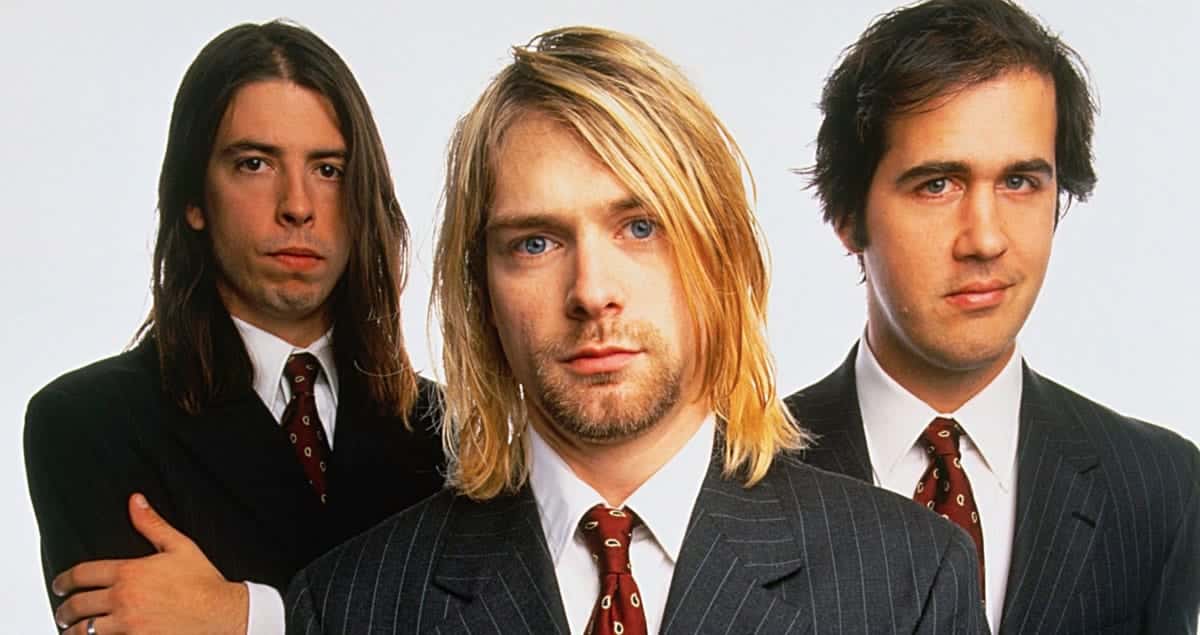
Nirvana: Minimalism, Distortion, and the Redefinition of Alternative Rock
Quick Facts
Founded: 1987
Origin: Aberdeen, Washington, USA
Genres: Grunge, Alternative Rock
Classic Line-Up: Kurt Cobain, Krist Novoselic, Dave Grohl
Years Active: 1987–1994
Origin Story – Isolation and Underground Influence
Nirvana was formed in 1987 by Kurt Cobain and Krist Novoselic in Aberdeen, Washington. The early years were unstable, with multiple drummers rotating through the lineup before Dave Grohl joined in 1990.
Cobain’s songwriting was shaped by two main influences: punk minimalism and melodic pop structure. Bands such as the Pixies influenced his use of quiet–loud dynamics. The regional Seattle scene also played a role, emphasizing raw production and emotional directness.
Their debut album, Bleach (1989), released on Sub Pop Records, reflected a heavier, sludgier sound aligned with early grunge aesthetics. The production was minimal, and the lyrics were often abstract.
While commercially modest, the album established credibility within the underground alternative scene.
The real shift came with their second release.
The Turning Point – Nevermind (1991)
In 1991, Nirvana signed to a major label and released Nevermind.
The album was produced with greater clarity than Bleach, but it retained the band’s dynamic contrasts. The core formula included:
Soft verse sections
Explosive distorted choruses
Simple chord progressions
Strong melodic hooks
The release coincided with growing dissatisfaction toward polished 1980s mainstream rock.
“Smells Like Teen Spirit” became an unexpected hit.
By early 1992, Nevermind displaced Michael Jackson from the top of the Billboard charts.
Nirvana had shifted from underground to global prominence within months.
Milestone Album – Nevermind (1991)
Nevermind is widely regarded as the album that brought alternative rock into mainstream visibility.
The production, handled by Butch Vig, emphasized clarity in drum sound and guitar layering. Dave Grohl’s drumming added precision and power compared to earlier recordings.
Tracks such as:
“Smells Like Teen Spirit”
“Come As You Are”
“Lithium”
demonstrated Cobain’s ability to merge abrasive guitar textures with accessible melodic phrasing.
Lyrically, the album avoided overt political messaging. Instead, it conveyed internal tension, detachment, and ambiguity.
The record’s impact extended beyond sales figures. It altered record label priorities, opening space for alternative bands to reach wider audiences.

Signature Song – Smells Like Teen Spirit
“Smells Like Teen Spirit” is structured around a four-chord progression repeated with dynamic variation.
The verse remains restrained, with muted guitar and measured vocals. The chorus introduces full distortion and intensified drumming.
The riff is simple but effective. The repetition reinforces memorability.
The lyrics are abstract, prioritizing tone over literal meaning. Cobain’s vocal delivery carries emotional urgency without detailed narrative.
The song became emblematic of early 1990s youth culture.
It did not invent alternative rock.
It amplified it.
Reaction to Success – In Utero (1993)
Following the overwhelming success of Nevermind, Nirvana sought to regain artistic control.
In Utero (1993), produced by Steve Albini, featured a rawer and less polished sound. The guitars were harsher, the drum tones less compressed, and the production intentionally abrasive.
Songs like “Heart-Shaped Box” and “All Apologies” retained melodic structure but rejected commercial smoothness.
The album demonstrated Cobain’s resistance to mainstream expectations.
Despite its harsher tone, In Utero still achieved commercial success.
Internal Pressure and Dissolution
Rapid fame placed significant strain on the band.
Cobain struggled with substance abuse and media attention. Public scrutiny intensified following his marriage to Courtney Love and the birth of their child.
Although the band maintained touring schedules, internal stability weakened.
In April 1994, Kurt Cobain died at age 27.
Nirvana disbanded immediately.
Unlike bands that evolve through lineup changes, Nirvana’s identity was inseparable from Cobain’s presence.
Members
Kurt Cobain – Vocals, Guitar
Krist Novoselic – Bass
Dave Grohl – Drums
Dave Grohl later formed Foo Fighters, continuing influence within alternative rock.
Studio Discography
Bleach (1989)
Nevermind (1991)
In Utero (1993)
Structural Contribution to Rock
Nirvana influenced modern rock in several measurable ways:
Quiet–Loud Dynamics
The use of soft verses followed by explosive choruses became widely adopted.Minimalist Song Structure
Simple chord progressions paired with melodic hooks redefined alternative accessibility.Underground to Mainstream Transition
They demonstrated that independent-style bands could achieve major commercial success.Cultural Realignment
The early 1990s shift away from glam metal toward grunge was accelerated by Nirvana’s breakthrough.
Unlike metal bands focused on technical complexity or theatrical rock acts emphasizing performance scale, Nirvana prioritized immediacy and emotional directness.
Legacy
Nirvana’s career was brief but transformative.
They did not create grunge alone, but they became its global representative.
Their influence persists in alternative, indie, and post-grunge movements.
The significance of Nirvana lies less in duration and more in disruption.
They shifted mainstream rock’s center of gravity.
And they did so with three studio albums.