
Pearl Jam: Longevity, Independence, and the Evolution of Grunge
Quick Facts
Founded: 1990
Origin: Seattle, Washington, USA
Genres: Grunge, Alternative Rock, Hard Rock
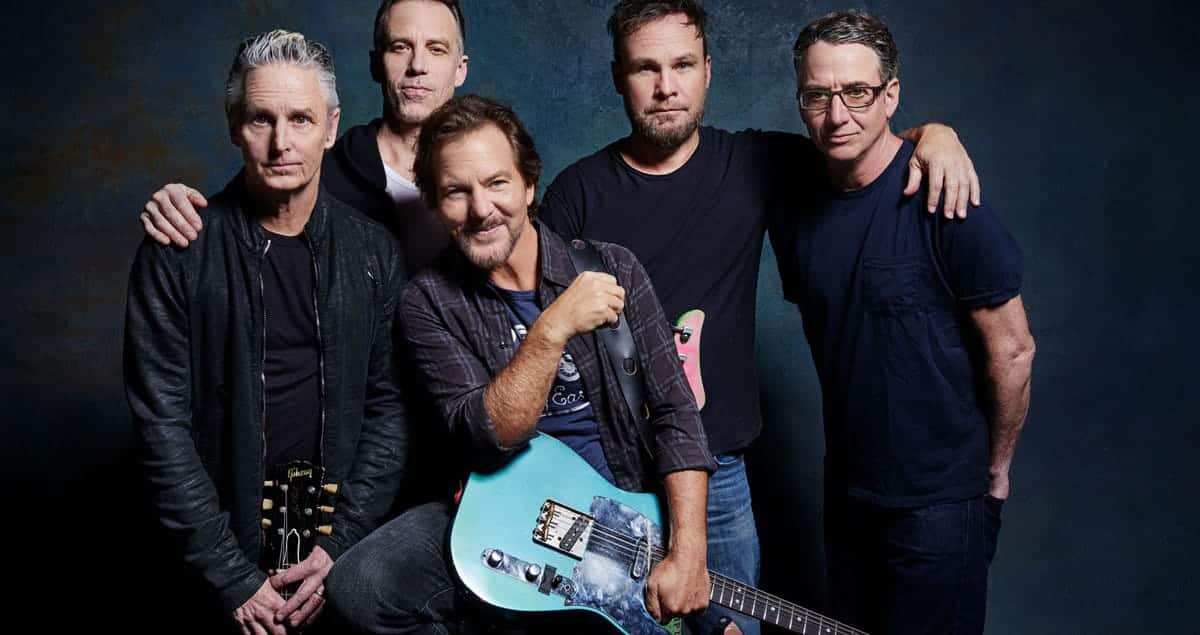
Classic Line-Up: Eddie Vedder, Stone Gossard, Mike McCready, Jeff Ament, Dave Abbruzzese (later: Matt Cameron)
Years Active: 1990–present
Origin Story – From Mother Love Bone to Pearl Jam
Pearl Jam emerged from the remnants of Mother Love Bone after the death of vocalist Andrew Wood in 1990. Guitarist Stone Gossard and bassist Jeff Ament began searching for a new direction.
They recorded instrumental demos and sent them to a young singer in San Diego named Eddie Vedder.
Vedder wrote lyrics and recorded vocal tracks over the demos, including what would become “Alive.” His tone and phrasing immediately fit the band’s heavier, guitar-driven structure.
By the time Mike McCready joined on lead guitar and Dave Krusen completed the early lineup on drums, the band had coalesced into Pearl Jam.
Their formation was rooted in the Seattle scene but structurally different from Nirvana. While Nirvana emphasized minimalism and distortion, Pearl Jam leaned toward classic rock-inspired composition and extended guitar interplay.
The Turning Point – Ten (1991)
Pearl Jam’s debut album, Ten, was released in 1991 — the same year as Nirvana’s Nevermind.
Initially, the album gained traction slowly. However, as the Seattle scene gained national attention, Ten rose in prominence.
The record featured:
Extended guitar solos
Prominent melodic hooks
Emotionally direct lyrics
Tracks such as “Alive,” “Even Flow,” and “Jeremy” became staples of early 1990s alternative radio.
Unlike Nirvana’s tight, compressed structures, Pearl Jam allowed songs to expand. Guitar solos were central rather than restrained.
Ten established Pearl Jam as one of the leading voices of the grunge era.
Milestone Album – Ten (1991)
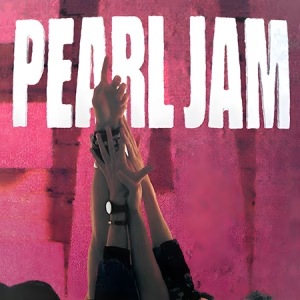
Ten remains Pearl Jam’s most commercially successful and culturally significant album.
The production emphasized layered guitars and strong vocal presence. Eddie Vedder’s baritone delivery added gravity to the material.
“Jeremy,” in particular, addressed social isolation and youth alienation. Its music video gained heavy rotation on MTV, increasing the band’s visibility.
While associated with grunge, the album drew heavily from classic rock traditions. The dual guitar approach of Gossard and McCready created a fuller harmonic field.
The album demonstrated that alternative rock could maintain complexity while achieving mainstream impact.
Signature Song – Alive
“Alive” is structured around a descending guitar riff with extended solo sections.
The song’s lyrical content explores identity and personal revelation. Vedder’s vocal phrasing moves from restraint in the verses to intensity in the chorus.
The extended guitar solo at the end distinguishes the band from more minimalist grunge peers.
“Alive” became a defining live performance piece, often expanded with improvisational elements.
Its durability over decades reinforced the band’s long-term appeal.
Resistance to Commercial Structures
After the success of Ten, Pearl Jam actively resisted aspects of the mainstream music industry.
They refused to produce traditional music videos after the early 1990s and publicly challenged Ticketmaster over concert pricing policies.
Albums such as Vs. (1993) and Vitalogy (1994) adopted rawer production styles and avoided overexposure.
Rather than capitalizing fully on commercial momentum, Pearl Jam prioritized autonomy.
This decision limited short-term mainstream saturation but strengthened their credibility.
Line-Up Stability and Evolution
Drummer changes marked the band’s early years, with Matt Cameron eventually becoming the long-term drummer in 1998.
The core songwriting partnership of Vedder, Gossard, and McCready provided continuity.
Throughout the 2000s and 2010s, albums such as Yield, Binaural, and Backspacer demonstrated stylistic flexibility without abandoning core identity.
Pearl Jam’s career trajectory emphasized steady evolution rather than dramatic reinvention.
Members (Core Line-Up)
Eddie Vedder – Vocals
Stone Gossard – Rhythm Guitar
Mike McCready – Lead Guitar
Jeff Ament – Bass
Matt Cameron – Drums
Eddie Vedder became the band’s primary lyrical voice and public representative.
Selected Studio Discography Highlights
Ten (1991)
Vs. (1993)
Vitalogy (1994)
No Code (1996)
Yield (1998)
Binaural (2000)
Pearl Jam (2006)
Lightning Bolt (2013)
Gigaton (2020)
Structural Contribution to Rock
Pearl Jam influenced rock in several key ways:
Extended Guitar Integration
Solos remained central in a genre moving toward minimalism.Industry Independence
Their confrontation with ticketing monopolies set a precedent for artist advocacy.Longevity Within Alternative Rock
They sustained relevance beyond the initial grunge wave.Live Performance Culture
Known for extensive touring and varied setlists, they cultivated a strong concert identity.
Unlike Nirvana’s short but disruptive trajectory, Pearl Jam’s impact is tied to endurance and gradual evolution.
Legacy
Pearl Jam stands as one of the most durable bands to emerge from the early 1990s alternative movement.
They balanced commercial success with principled independence. While their early work is closely associated with grunge, their broader catalog reflects classic rock structure adapted for modern audiences.
Their legacy is defined not by disruption alone, but by sustained presence.
They outlasted the movement that introduced them.