
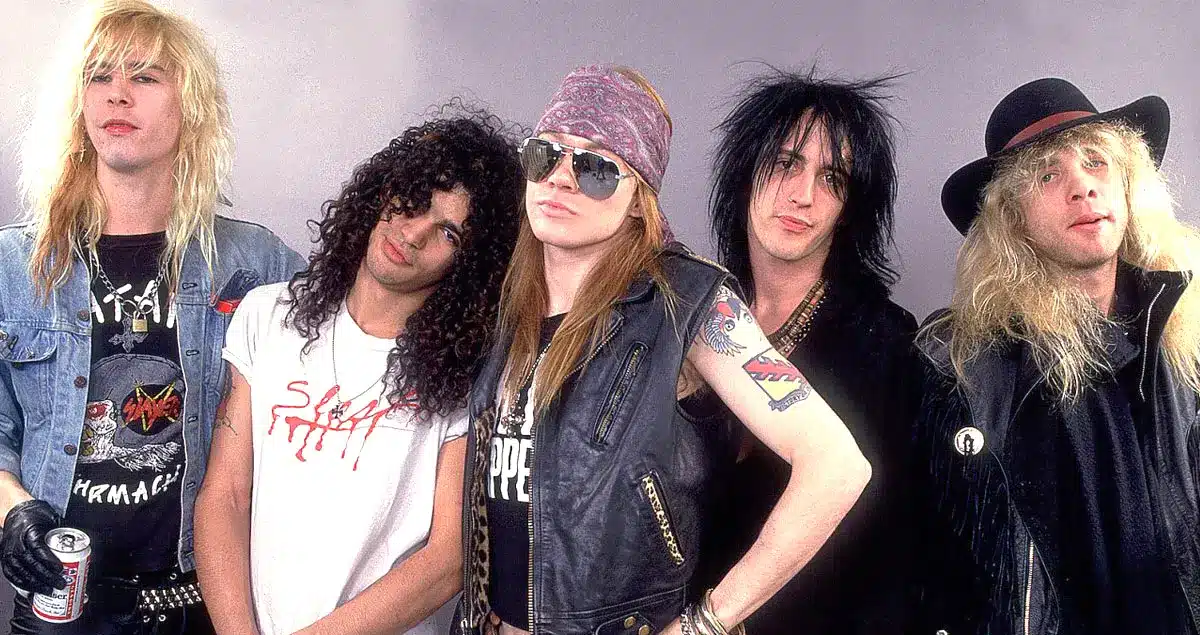
Guns N’ Roses: Excess, Precision, and the Last Era of Classic Hard Rock
Quick Facts
Founded: 1985
Origin: Los Angeles, California, USA
Genres: Hard Rock, Heavy Metal
Classic Line-Up: Axl Rose, Slash, Duff McKagan, Izzy Stradlin, Steven Adler
Years Active: 1985–present
Origin Story – The Sunset Strip Convergence
Guns N’ Roses formed in 1985 from the merger of two Los Angeles bands: L.A. Guns and Hollywood Rose. Axl Rose and Izzy Stradlin came from Hollywood Rose, while guitarist Slash and drummer Steven Adler had roots in the Sunset Strip scene.
The Los Angeles hard rock environment of the mid-1980s was dominated by glam aesthetics and polished production. Guns N’ Roses adopted elements of that scene but leaned toward a more aggressive, street-oriented image.
Their early performances were chaotic but focused. Unlike many contemporaries who emphasized visual style over musicianship, Guns N’ Roses prioritized tight rhythm sections and strong guitar interplay.
By 1987, the lineup had stabilized around five members who defined the band’s most influential era.
The Turning Point – Appetite for Destruction (1987)
Their debut album, Appetite for Destruction, was released in 1987 with minimal initial impact. However, through touring and growing radio exposure, the album gained traction.
The production emphasized:
Clear, aggressive guitar tone
Defined bass presence
Controlled drumming
Distinct vocal phrasing
Songs like “Welcome to the Jungle,” “Paradise City,” and “Sweet Child o’ Mine” combined hard rock structure with melodic hooks.
Unlike heavily polished glam metal releases of the period, Appetite for Destruction retained grit without sacrificing clarity.
By 1988, the album reached number one on the Billboard charts.
It became one of the best-selling debut albums in history.
Milestone Album – Appetite for Destruction (1987)
Appetite for Destruction is widely considered the band’s defining statement.
Key characteristics include:
Riff-driven songwriting
Structured guitar solos
Dynamic vocal intensity
Concise arrangement
Slash’s guitar work balanced blues-influenced phrasing with precise melodic construction. Duff McKagan’s bass lines reinforced rhythmic tightness. Steven Adler’s drumming added swing to otherwise aggressive material.
Axl Rose’s vocal range — capable of shifting from lower registers to high-pitched screams — provided dynamic contrast.
The album reasserted hard rock’s relevance at a time when glam metal had become formulaic.
Signature Song – Sweet Child o’ Mine
“Sweet Child o’ Mine” began as a guitar exercise by Slash. The opening riff, built around a repeating melodic pattern, became one of the most recognizable introductions in rock.
The song follows a clear structure:
Intro riff
Verse
Chorus
Extended solo
Gradual tempo build
Unlike more aggressive tracks on the album, this song emphasized melodic clarity.
Its commercial success broadened the band’s audience beyond hard rock circles.
The balance between technical soloing and accessible songwriting became a key element of their appeal.
Expansion and Internal Conflict
Following the success of their debut, Guns N’ Roses released Use Your Illusion I and Use Your Illusion II in 1991.
These albums expanded stylistically:
Longer compositions
Piano-driven ballads
Orchestral arrangements
Broader lyrical themes
Tracks such as “November Rain” demonstrated ambition beyond standard hard rock structure.
However, internal tensions increased. Differences in creative direction and personal behavior led to lineup instability.
Izzy Stradlin departed in 1991. Steven Adler had already been replaced. Slash and Duff McKagan left the band by the mid-1990s.
The classic lineup dissolved within a decade of formation.
Reformation and Continuity
In the 2000s, Axl Rose continued under the Guns N’ Roses name with new musicians. The long-delayed album Chinese Democracy (2008) reflected extensive production layering but lacked the cohesion of earlier work.
In 2016, Slash and Duff McKagan rejoined the band for the “Not in This Lifetime” tour. The reunion generated significant global attendance, reaffirming the lasting appeal of the classic-era material.
Members (Classic Line-Up)
Axl Rose – Vocals
Slash – Lead Guitar
Duff McKagan – Bass
Izzy Stradlin – Rhythm Guitar
Steven Adler – Drums
Later drummers included Matt Sorum and Frank Ferrer.
Selected Studio Discography Highlights
Appetite for Destruction (1987)
G N’ R Lies (1988)
Use Your Illusion I (1991)
Use Your Illusion II (1991)
The Spaghetti Incident? (1993)
Chinese Democracy (2008)
Structural Contribution to Rock
Guns N’ Roses influenced rock in several ways:
Reassertion of Hard Rock Authenticity
They shifted focus from glam aesthetics back to riff-centered songwriting.Extended Guitar Solo Revival
Slash’s melodic solo style became a reference point for late-1980s rock guitar.Album Expansion Strategy
The dual Use Your Illusion releases demonstrated large-scale ambition.Hybridization of Blues and Modern Hard Rock
Their approach maintained traditional influences within contemporary production.
Unlike Metallica’s precision-based aggression or AC/DC’s minimalism, Guns N’ Roses combined volatility with structured musicianship.
Legacy
Guns N’ Roses represents the final large-scale hard rock explosion before the rise of grunge.
Their debut album remains a benchmark for hard rock production and songwriting efficiency.
Although internal instability limited the duration of their classic lineup, their catalog continues to dominate live setlists and streaming platforms.
Their impact lies in intensity — both musical and interpersonal.
They did not simplify hard rock.
They intensified it.