
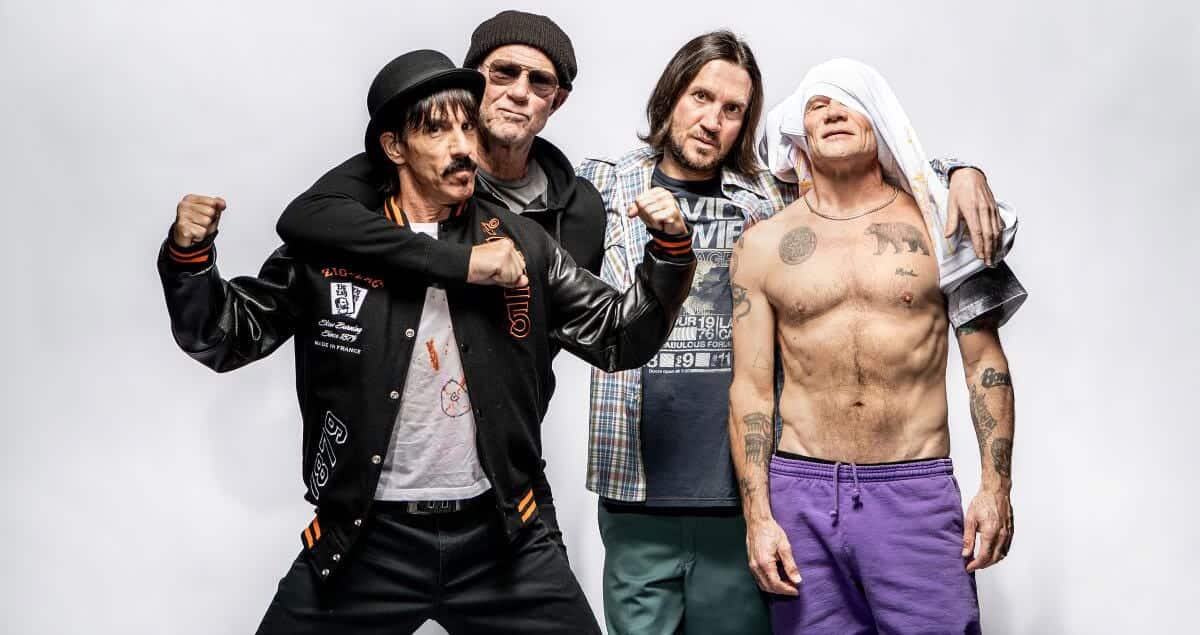
Red Hot Chili Peppers: Funk Integration, Adaptation, and Alternative Longevity
Quick Facts
Founded: 1983
Origin: Los Angeles, California, USA
Genres: Alternative Rock, Funk Rock, Rap Rock
Classic Line-Up: Anthony Kiedis, Flea, John Frusciante, Chad Smith
Years Active: 1983–present
Origin Story – Funk and Punk Convergence
Red Hot Chili Peppers were formed in Los Angeles in 1983 by vocalist Anthony Kiedis and bassist Flea, alongside guitarist Hillel Slovak and drummer Jack Irons.
The band’s early identity combined punk energy with funk rhythm. Flea’s bass playing was central from the beginning. Rather than functioning purely as a rhythmic support instrument, his bass lines carried melodic and percussive momentum.
Their self-titled debut (1984) showed potential but lacked cohesion. Subsequent albums such as Freaky Styley (1985) leaned further into funk influences, working with producer George Clinton.
However, instability affected the early years. Hillel Slovak struggled with substance abuse and died in 1988. Jack Irons departed shortly afterward.
The band faced a structural reset.
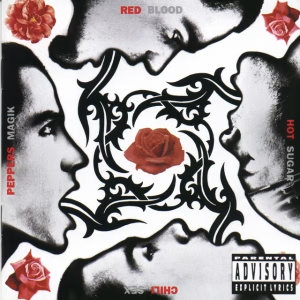
The Turning Point – Blood Sugar Sex Magik (1991)
With guitarist John Frusciante and drummer Chad Smith joining, the band entered its most influential era.
Released in 1991 and produced by Rick Rubin, Blood Sugar Sex Magik balanced funk-driven grooves with more structured alternative songwriting.
Key elements included:
Clean, articulated bass lines
Minimal but effective guitar riffs
Dynamic vocal phrasing
Reduced production layering
Tracks such as “Give It Away” emphasized rhythmic repetition, while “Under the Bridge” introduced introspective lyricism and melodic restraint.
The album expanded their audience significantly and repositioned them within alternative rock rather than niche funk scenes.
Milestone Album – Blood Sugar Sex Magik (1991)
Blood Sugar Sex Magik marked the band’s creative breakthrough.
Unlike earlier chaotic releases, this album demonstrated cohesion. The interplay between Flea’s bass and Frusciante’s guitar created space rather than density.
“Under the Bridge” showcased a departure from the band’s earlier, more playful persona. The song focused on isolation and vulnerability.
The album demonstrated that the band could maintain rhythmic identity while expanding emotional range.
It remains a foundational alternative rock release of the early 1990s.
Signature Song – Under the Bridge
“Under the Bridge” is structured around a clean guitar progression with minimal distortion.
The verses are subdued, allowing Kiedis’ vocals to carry the lyrical weight. The chorus introduces layered harmonies but avoids heavy instrumentation.
The arrangement builds gradually rather than abruptly.
The song’s accessibility and sincerity broadened the band’s mainstream presence.
It remains one of their most recognizable and enduring tracks.
Instability and Reinvention
After the success of Blood Sugar Sex Magik, John Frusciante left the band due to discomfort with sudden fame.
Subsequent albums such as One Hot Minute (1995), recorded with guitarist Dave Navarro, shifted toward heavier and darker tones but did not achieve the same cohesion.
Frusciante returned in 1998, leading to the release of Californication (1999).
This album streamlined the band’s sound:
Simpler chord progressions
Emphasis on melody
Cleaner production
Songs like “Scar Tissue” and “Californication” demonstrated restraint and maturity.
The band sustained momentum with By the Way (2002) and Stadium Arcadium (2006), balancing funk roots with alternative rock structures.
Line-Up Stability and Modern Era
John Frusciante departed again in 2009, replaced by Josh Klinghoffer. In 2019, Frusciante rejoined the band.
Unlike many 1980s alternative acts, Red Hot Chili Peppers maintained cultural presence across decades.
Their adaptability — shifting between funk-driven experimentation and melodic alternative rock — allowed them to navigate changing musical landscapes.
Members (Classic Line-Up)
Anthony Kiedis – Vocals
Flea – Bass
John Frusciante – Guitar
Chad Smith – Drums
Flea and Kiedis remain the foundational members.
Selected Studio Discography Highlights
The Red Hot Chili Peppers (1984)
Freaky Styley (1985)
Mother’s Milk (1989)
Blood Sugar Sex Magik (1991)
Californication (1999)
By the Way (2002)
Stadium Arcadium (2006)
Unlimited Love (2022)
Structural Contribution to Rock
Red Hot Chili Peppers influenced alternative rock through:
Funk Integration into Mainstream Rock
Bass-led composition became central rather than supportive.Dynamic Minimalism
Guitar restraint emphasized groove over distortion.Genre Fluidity
The band navigated rap, funk, alternative, and pop without losing identity.Longevity Through Adaptation
They remained active across multiple generational shifts.
Unlike grunge bands defined by short-term disruption, Red Hot Chili Peppers built sustained relevance through controlled evolution.
Legacy
Red Hot Chili Peppers represent a bridge between 1980s funk-rock experimentation and modern alternative mainstream.
They did not rely on technical complexity or theatrical scale. Their influence lies in groove, interplay, and adaptability.
Their longevity demonstrates that rhythmic identity can sustain across decades when paired with structural flexibility.