
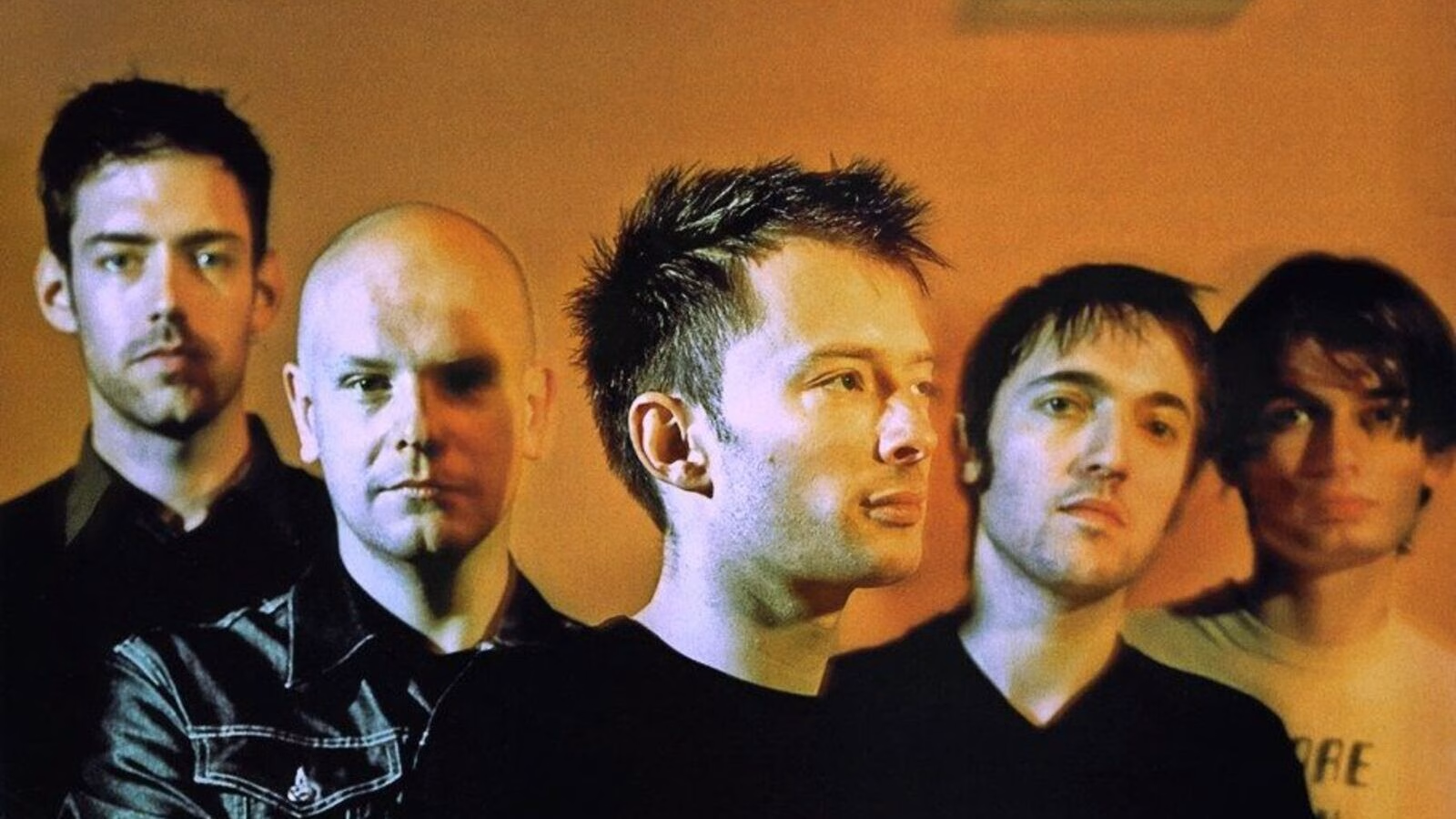
Radiohead: Reinvention, Atmosphere, and the Redefinition of Alternative Rock
Quick Facts
Founded: 1985 (as On a Friday), renamed Radiohead in 1991
Origin: Abingdon, Oxfordshire, England
Genres: Alternative Rock, Art Rock, Electronic Rock
Classic Line-Up: Thom Yorke, Jonny Greenwood, Colin Greenwood, Ed O’Brien, Philip Selway
Years Active: 1985–present
Origin Story – From School Band to Major Label
Radiohead began as a school band named On a Friday, formed by Thom Yorke, the Greenwood brothers, Ed O’Brien, and Philip Selway. After signing to a record label in the early 1990s, they adopted the name Radiohead.
Their debut album, Pablo Honey (1993), featured the single “Creep.” The song became a commercial hit but initially overshadowed the band’s broader ambitions. The album itself followed a conventional alternative rock format.
Rather than repeating that formula, Radiohead shifted direction.
Their second album, The Bends (1995), demonstrated increased compositional depth. The production was cleaner, and the arrangements more expansive. Tracks such as “Fake Plastic Trees” and “Street Spirit (Fade Out)” reflected growing emotional and structural sophistication.
The band was evolving beyond standard alternative rock.
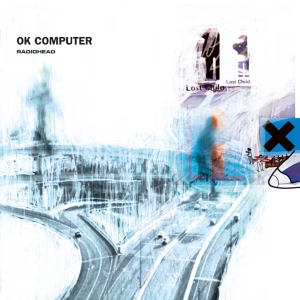
The Turning Point – OK Computer (1997)
OK Computer marked Radiohead’s transformation from successful alternative band to critical benchmark.
Released in 1997, the album expanded thematic scope and production complexity. It addressed alienation, technological anxiety, and social disconnection.
Musically, the album incorporated:
Layered guitar textures
Ambient sound design
Unconventional song structures
Tracks such as “Paranoid Android” demonstrated multi-section composition, while “Karma Police” balanced accessibility with tension.
The album received widespread critical acclaim and is frequently cited among the most important records of the 1990s.
It positioned Radiohead as innovators rather than followers.
Milestone Album – OK Computer (1997)
OK Computer remains Radiohead’s most widely recognized album.
Its structural significance lies in cohesion. Songs transition with thematic consistency, and the production emphasizes atmosphere over traditional rock dynamics.
“Paranoid Android” moves through multiple tempo and mood shifts within a single track. “No Surprises” uses restrained instrumentation to contrast lyrical unease.
Rather than relying solely on distortion or volume, the album builds tension through texture and layering.
It expanded expectations for alternative rock albums at the close of the decade.
Signature Song – Paranoid Android
“Paranoid Android” exemplifies Radiohead’s structural ambition.
The track unfolds in sections:
Melodic opening
Distorted midsection
Choral-like harmonic transition
Climactic resolution
There is no repetitive chorus in the traditional sense. The composition prioritizes progression.
Jonny Greenwood’s guitar work blends melodic phrasing with experimental textures. Thom Yorke’s vocal delivery shifts between restraint and intensity.
The song reinforced Radiohead’s willingness to abandon formula.
Reinvention – Kid A (2000)
Following the success of OK Computer, Radiohead avoided repetition.
Kid A (2000) incorporated electronic instrumentation, sampling, and minimal guitar presence. Influences from ambient and electronic music replaced conventional rock structures.
Songs such as “Everything in Its Right Place” centered on texture rather than riff.
The album initially divided listeners but later became recognized as a pivotal moment in alternative music.
Radiohead demonstrated that reinvention was integral to their identity.
Stability and Continued Evolution
Unlike many alternative acts, Radiohead maintained consistent membership throughout their career.
Subsequent albums, including Amnesiac (2001), In Rainbows (2007), and A Moon Shaped Pool (2016), blended electronic elements with orchestration and controlled guitar reintroduction.
In Rainbows also became notable for its pay-what-you-want digital release strategy, challenging traditional distribution models.
The band’s evolution was measured rather than abrupt. Each album adjusted sonic emphasis while preserving thematic continuity.
Members
Thom Yorke – Vocals, Piano, Guitar
Jonny Greenwood – Guitar, Keyboards
Colin Greenwood – Bass
Ed O’Brien – Guitar
Philip Selway – Drums
Jonny Greenwood’s orchestral compositions outside the band further extended their artistic reach.
Selected Studio Discography Highlights
Pablo Honey (1993)
The Bends (1995)
OK Computer (1997)
Kid A (2000)
Amnesiac (2001)
Hail to the Thief (2003)
In Rainbows (2007)
A Moon Shaped Pool (2016)
Structural Contribution to Alternative Rock
Radiohead influenced modern music through:
Album-Level Cohesion
Emphasis on thematic and sonic continuity across full-length releases.Integration of Electronic Elements
Alternative rock expanded beyond guitar-centric frameworks.Distribution Innovation
Non-traditional release strategies influenced digital music economics.Atmospheric Production
Texture became as important as melody.
Unlike grunge bands driven by distortion or metal bands defined by speed, Radiohead prioritized reinvention and sonic architecture.
Legacy
Radiohead’s influence extends across alternative, indie, and experimental music.
Their career demonstrates sustained innovation without abandoning core identity.
They redefined alternative rock not by increasing volume or speed, but by expanding structure and atmosphere.
Their significance lies in evolution.
They changed direction — repeatedly — and maintained coherence.