
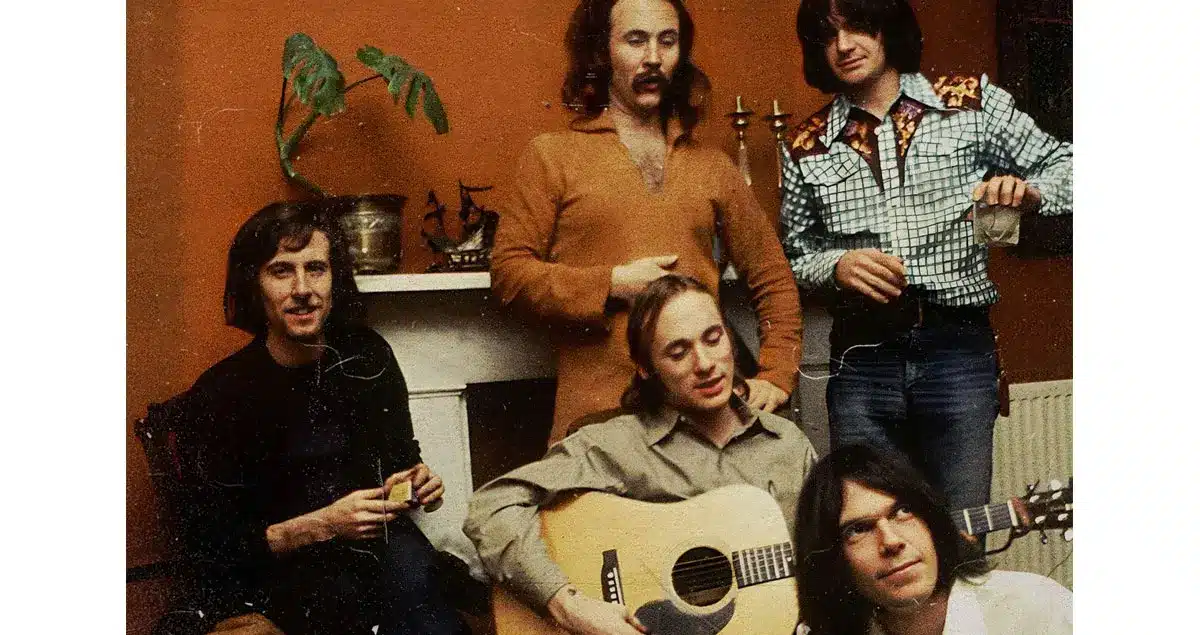
Crosby, Stills, Nash & Young: Harmonic Architecture, Internal Friction, and the Controlled Power of American Rock
Crosby, Stills, Nash & Young are frequently remembered as a harmony-driven folk-rock collective emblematic of a specific American era. This framing, while culturally convenient, fails to capture the structural force embedded in their music. Beneath the acoustic surfaces and vocal blending lies one of the most disciplined and tension-driven configurations in classic rock history.
CSNY were not a loose gathering of idealists harmonizing in pastoral unity. They were a volatile coalition of strong individual identities forced into a single structural framework. Their power did not emerge from softness or communal warmth. It emerged from harmonic architecture under pressure.
They did not invent harmony in rock. They weaponized it.
The Supergroup Problem — and Its Resolution
Supergroups often collapse under ego imbalance. CSNY, however, converted ego into structural tension. Each member brought a distinct stylistic identity:
David Crosby: abstract harmonic sensibility
Stephen Stills: rhythmic and blues-driven foundation
Graham Nash: melodic clarity and pop discipline
Neil Young: raw tonal unpredictability
Instead of smoothing these differences, the band allowed them to coexist in friction. This friction became the engine.
Unlike many harmony-based groups, CSNY did not aim for seamless unity. Their vocal blends are precise, but the underlying personalities remain audible. That subtle instability creates pressure within the harmony itself.
In hard rock terms, this tension functions similarly to distorted guitars—an undercurrent of instability that strengthens impact.
Harmony as Structural Command
Vocal harmony in CSNY is often described as beautiful, but beauty is not its primary function. It is architectural.
Their harmonies:
Define chord structure explicitly
Eliminate harmonic ambiguity
Reinforce lyrical emphasis
Each voice occupies a defined frequency band, creating a sonic block rather than a layered texture. The effect is commanding rather than delicate.
This differs fundamentally from softer folk traditions. CSNY harmonies do not drift. They lock. The clarity of their voicing makes even acoustic arrangements feel forceful.
Harmony becomes authority.
Neil Young: Distortion Within the Framework
Neil Young’s presence is crucial to understanding CSNY’s power. His guitar tone and vocal phrasing introduce instability into an otherwise controlled environment.
Young’s characteristics include:
Abrasive electric tone
Sparse but emotionally charged phrasing
Minimalist solo construction
When electric elements emerge, they disrupt the harmonic equilibrium without destroying it. This tension between acoustic clarity and electric abrasion anticipates the dynamic contrasts later embraced by alternative and hard rock bands.
Young’s refusal to smooth his edges prevents CSNY from becoming ornamental. His contributions inject risk into precision.
Rhythm and Restraint
CSNY rhythm sections rarely dominate. Instead, they provide stable frameworks that allow harmonies to carry weight.
Key features include:
Mid-tempo pacing
Subtle dynamic build-ups
Controlled percussion emphasis
Rather than relying on groove, the band builds momentum through layering and vocal intensity. This approach aligns with certain strands of classic rock that prioritize structural development over rhythmic flash.
The restraint is intentional. By avoiding rhythmic overstatement, the band amplifies harmonic impact.
Song Construction: Expansion Without Chaos
CSNY compositions often unfold gradually. Songs build in layers rather than explode.
Structural traits include:
Extended intros
Gradual instrumental entry
Climaxes rooted in vocal convergence
Unlike jam-based rock, these expansions are controlled. Improvisation exists, but within defined boundaries. There is no loss of structure.
This balance between expansion and containment mirrors hard rock’s most disciplined forms. Power is achieved through accumulation, not volume spikes.
Political Voice Without Loss of Control
CSNY’s association with protest movements can obscure their musical discipline. Their political themes are delivered not with raw rage, but with calculated composure.
This approach:
Strengthens lyrical credibility
Avoids emotional exaggeration
Reinforces authority
The restraint makes statements more powerful. The band does not shout. It asserts.
In classic rock lineage, this measured delivery positions CSNY closer to structurally disciplined acts than to emotionally volatile protest singers.
Studio Precision
Production in CSNY recordings emphasizes clarity and balance. Vocal lines are meticulously placed. Instruments are separated but cohesive.
This creates:
Transparent harmonic interaction
Controlled dynamic range
Emphasis on articulation
Even when electric guitars intensify, the mix avoids saturation. This preservation of space reinforces authority. Nothing blurs. Every voice remains accountable.
Such precision demands strong material. There is nowhere to hide.
Internal Conflict as Creative Catalyst
CSNY’s internal tensions are well-documented, but what matters musically is how those tensions translate into output.
Conflict results in:
Heightened vocal urgency
Sharper structural decisions
Clearer division of musical roles
Rather than dissolving the group’s identity, friction sharpens it. This parallels hard rock bands where internal volatility fuels disciplined output rather than chaos.
The music reflects a balance between cooperation and resistance.
Live Dynamics: Precision Under Pressure
CSNY live performances often reveal the delicate balance within the group. Acoustic sets emphasize harmonic dominance, while electric sections introduce volatility.
Characteristics include:
Faithful vocal reproduction
Controlled dynamic shifts
Occasional bursts of electric tension
The band’s ability to maintain vocal clarity in live contexts reinforces their structural discipline. There is little theatrical embellishment. Authority stems from execution.
Influence: The Architecture of American Harmony Rock
CSNY’s influence extends far beyond folk-rock categorization. They established a model where:
Harmony equals structural weight
Political themes coexist with musical precision
Individual identities strengthen collective output
Later American rock acts adopted this blueprint, particularly those blending introspection with controlled arrangement.
Their harmonic discipline can also be traced indirectly through arena rock bands emphasizing vocal unity over instrumental chaos.
Longevity Through Defined Roles
CSNY’s catalog remains cohesive because each member’s role remains distinct. This clarity prevents stylistic drift.
Core principles persist:
Vocal architecture as foundation
Structured expansion
Controlled tension
This consistency allows their recordings to age without becoming artifacts of a specific trend.
Conclusion: Harmony Under Pressure
Crosby, Stills, Nash & Young are not simply a harmony group. They are a case study in how harmony can function as structural command rather than ornamentation.
Their power lies in tension contained within precision. They demonstrate that acoustic instruments and vocal blending can carry the same authority as amplified distortion when executed with discipline.
In the broader lineage of classic rock, CSNY represent a branch where control outweighs chaos and architecture outweighs spectacle.
They did not soften rock.
They restructured it—through voices locked in deliberate tension.