
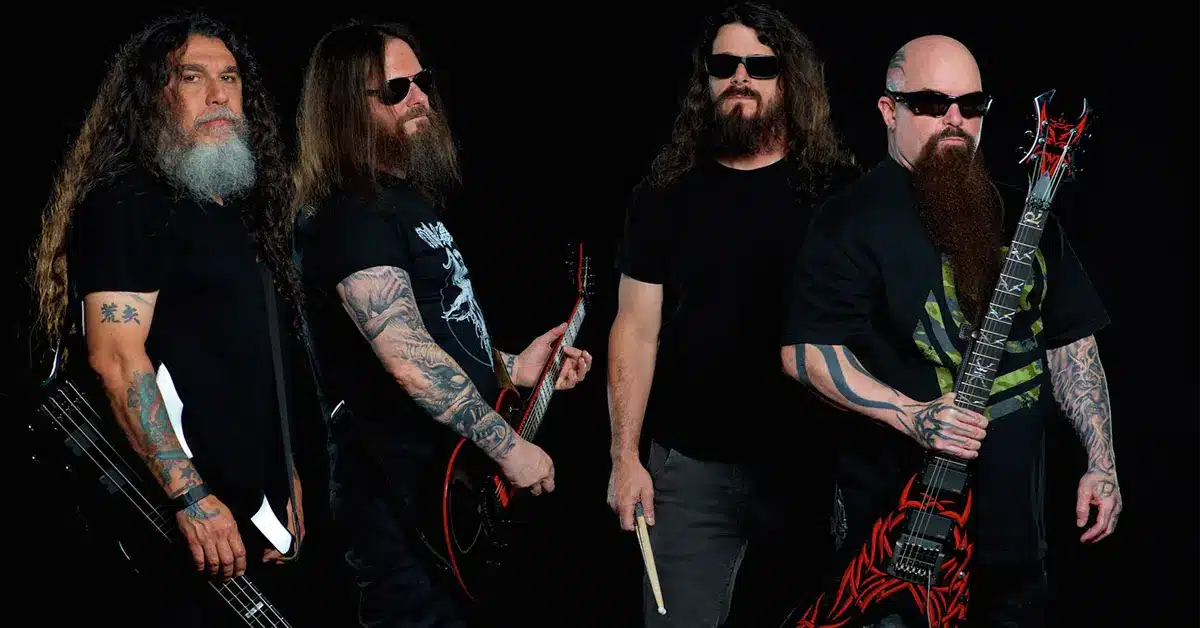
Slayer: Speed, Control, and the Architecture of Extreme Thrash Metal
Quick Facts
Founded: 1981
Origin: Huntington Park, California, USA
Genres: Thrash Metal
Classic Line-Up: Tom Araya, Kerry King, Jeff Hanneman, Dave Lombardo
Years Active: 1981–2019
Origin Story – The Fastest Band in the Room
Slayer formed in 1981 when guitarists Kerry King and Jeff Hanneman began rehearsing together in Southern California. Tom Araya joined as bassist and vocalist, and drummer Dave Lombardo completed the lineup shortly after.
The early 1980s Los Angeles metal scene was divided. Glam metal dominated the Sunset Strip. Meanwhile, a small underground movement was pushing metal toward greater speed and aggression. Slayer aligned with the latter.
Unlike Metallica, who were incorporating complex arrangements and melodic transitions, Slayer moved toward compression and acceleration. Their objective was not progressive expansion but impact.
The debut album, Show No Mercy (1983), already displayed:
Tremolo-picked riffing
Rapid tempo shifts
Minimal melodic resolution
Dark, confrontational themes
The production was raw but precise enough to showcase tight ensemble playing. Slayer was not experimenting with different styles. They were sharpening a single one.
Establishing Identity – Hell Awaits
With Hell Awaits (1985), Slayer increased structural sophistication without sacrificing speed. The songs became longer and more layered. Guitar harmonies were replaced with darker interval choices, emphasizing tension rather than resolution.
Dave Lombardo’s drumming advanced beyond standard thrash patterns. His double-bass technique became central to the band’s rhythmic identity.
Jeff Hanneman and Kerry King’s guitar interplay avoided traditional dual-lead harmony common in Iron Maiden or Judas Priest. Instead, they pursued dissonance and aggressive phrasing.
Slayer was separating itself from other emerging thrash bands.
Turning Point – Reign in Blood (1986)
In 1986, Slayer released Reign in Blood, produced by Rick Rubin.
This album remains their defining statement.
Unlike Hell Awaits, which allowed some progressive extension, Reign in Blood compressed its runtime to under 30 minutes. The songs were shorter, tighter, and more concentrated.
Key characteristics:
High-speed riff sequencing
Clear but unpolished production
Minimal intros or transitions
Continuous forward momentum
The album opens with “Angel of Death,” immediately establishing tempo and intensity.
There is no gradual build.
Slayer removed structural padding.
The result was one of the most influential extreme metal albums ever recorded.
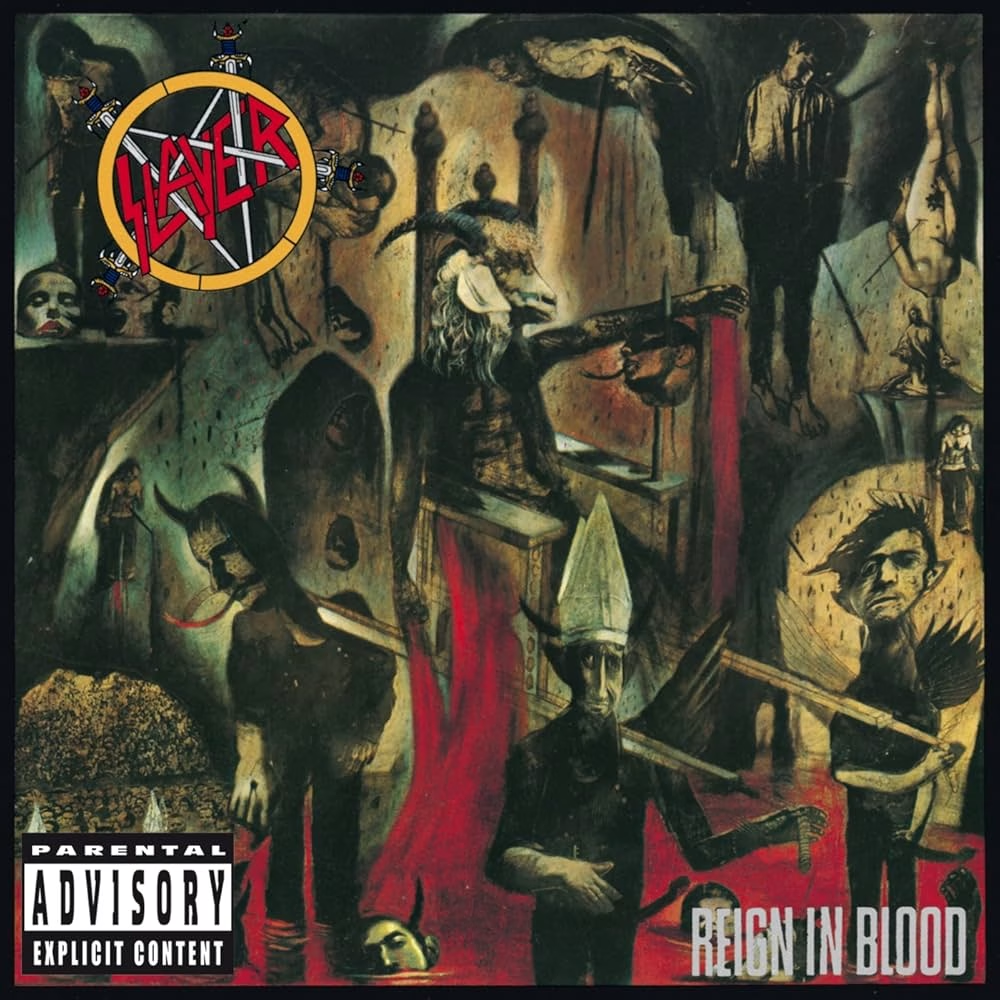
Milestone Album – Reign in Blood
Reign in Blood refined thrash metal into its most aggressive form without losing technical clarity.
The production avoided excessive studio layering. Guitars cut sharply through the mix. The bass supported rhythm rather than dominating. Lombardo’s drums remained audible despite speed.
Unlike many metal bands that rely on melodic choruses, Slayer structured songs around riff succession.
Each track functions as a sequence of high-intensity passages rather than verse–chorus repetition.
This approach influenced later death metal and black metal movements.
The album did not expand metal outward.
It intensified it inward.
Signature Song – Raining Blood
“Raining Blood” remains Slayer’s most recognized track.
The song begins with atmospheric guitar layering before introducing a descending riff pattern.
The structure includes:
Intro tension build
High-speed main riff
Mid-tempo breakdown
Climactic closing riff
Tom Araya’s vocal delivery remains controlled and rhythmic. He avoids melodic ornamentation, focusing on direct projection.
The final riff repetition reinforces memorability without relying on traditional hooks.
The song became central to Slayer’s live identity and remains a thrash metal benchmark.
Expansion Without Softening – South of Heaven and Seasons in the Abyss
After Reign in Blood, Slayer released South of Heaven (1988), which slowed tempos slightly to explore tension through pacing rather than speed alone.
The shift demonstrated structural discipline. Rather than repeating the previous album’s velocity, they diversified rhythm without sacrificing aggression.
Seasons in the Abyss (1990) balanced both approaches:
Controlled tempo variation
Focused riff writing
Improved production clarity
These albums showed that Slayer could adjust pacing while maintaining core identity.
They were not one-dimensional.
They were selective.
Instrumental Architecture
Slayer’s internal dynamic was built on role clarity.
Jeff Hanneman contributed darker, often more atmospheric riff structures. Kerry King leaned toward aggressive lead phrasing. Together, they formed a dual-guitar attack that emphasized density over harmony.
Dave Lombardo’s drumming became foundational to extreme metal technique. His ability to sustain speed without losing precision elevated the band beyond raw aggression.
Tom Araya’s bass playing reinforced rhythm while his vocal approach maintained intensity without excessive range shifts.
The band operated as a cohesive unit rather than spotlighting individual virtuosity.
Line-Up Instability and Final Phase
Dave Lombardo temporarily left in the 1990s, later returning before departing again. Jeff Hanneman passed away in 2013, marking the end of the original creative core.
Gary Holt joined as touring guitarist and later recorded with the band.
Despite these changes, Slayer maintained stylistic consistency until their final album, Repentless (2015).
In 2019, Slayer concluded their farewell tour, formally ending active operations.
They chose closure rather than gradual decline.
Selected Studio Discography
Show No Mercy (1983)
Hell Awaits (1985)
Reign in Blood (1986)
South of Heaven (1988)
Seasons in the Abyss (1990)
Divine Intervention (1994)
God Hates Us All (2001)
Repentless (2015)
Structural Contribution to Metal
Slayer influenced heavy music through:
Tempo Standardization
Raised speed expectations across thrash and extreme metal.Riff Compression
Prioritized concise, high-impact song structures.Dissonant Guitar Language
Reduced reliance on melodic harmony in favor of tension.Consistency Over Reinvention
Maintained identity across decades without mainstream softening.
Unlike Metallica’s progressive expansion or Megadeth’s technical intricacy, Slayer focused on acceleration and density.
They did not evolve toward accessibility.
They refined extremity.
Legacy
Slayer stands among the foundational architects of thrash metal.
Their importance is not measured in chart positions but in structural influence. Later extreme metal genres adopted their speed, tonal aggression, and compressed composition model.
They sustained intensity without dilution.
They did not adapt to trends.
They maintained velocity until the end.