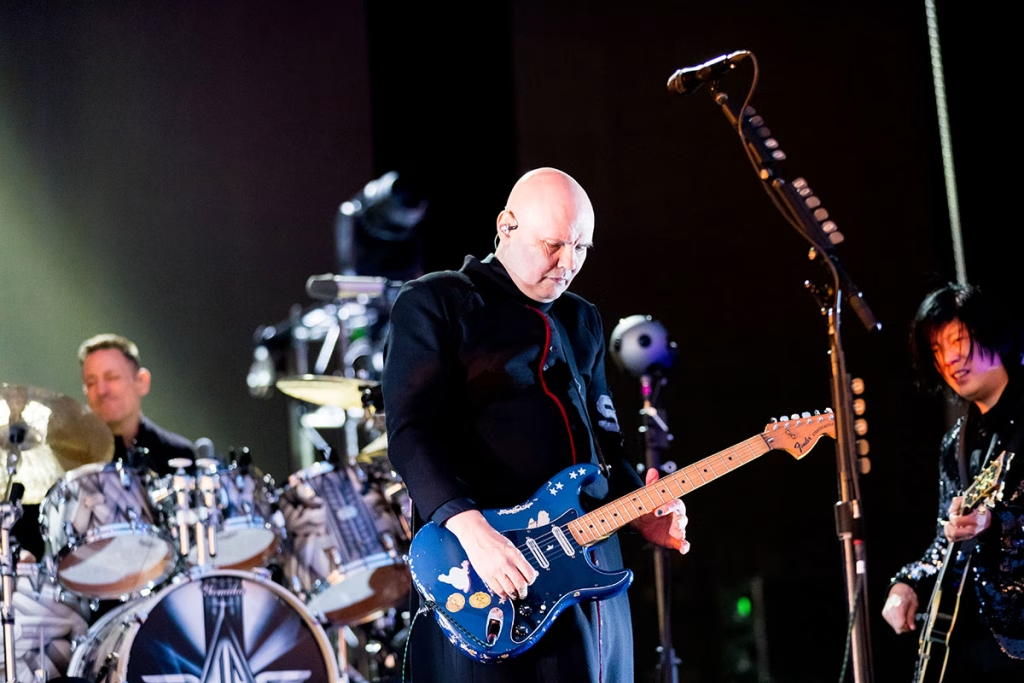

The Smashing Pumpkins Didn’t Choose an Identity — They Refused to Collapse Into One
The Smashing Pumpkins are often described as maximalist, emotional, dramatic, or ambitious. All true — and all incomplete.
What defines them isn’t scale or intensity, but instability.
They never settle into a single musical self. Instead, they operate as a fractured system, where softness and aggression, fragility and control, coexist without reconciliation. This isn’t versatility for its own sake — it’s unresolved tension made audible.
RMU lens:
The Smashing Pumpkins are a band that refuses emotional consistency.
Density as Emotional Strategy
Where many bands use distortion to amplify power, The Smashing Pumpkins use it to blur certainty.
Guitars stack until edges disappear
Melody fights to surface through noise
Texture overwhelms clarity
This density doesn’t create heaviness — it creates emotional overload. You’re not meant to follow clean lines; you’re meant to feel submerged. The sound behaves like memory: layered, distorted, and impossible to isolate.
RMU framing:
Their wall of sound isn’t force — it’s confusion with momentum.
Vulnerability Without Intimacy
Despite their emotional openness, The Smashing Pumpkins rarely feel intimate.
Why? Because vulnerability is presented at scale.
Feelings are exaggerated
Pain is aestheticized
Confession becomes performance
You hear emotion, but you don’t enter it. The distance remains. This creates a strange paradox: deeply personal music that still feels theatrical.
RMU insight:
Exposure doesn’t guarantee closeness.
Control Hidden Inside Excess
The band’s music often sounds indulgent, sprawling, even uncontrolled. But underneath the surface is rigid authorship.
Arrangements are tightly managed
Dynamics are deliberately extreme
Emotional pacing is engineered
Chaos here is curated. Excess is intentional. Nothing spills by accident.
This is why the music feels dramatic rather than messy — every swell, collapse, and return is designed.
Why They Never Fully Belonged to an Era
The Smashing Pumpkins are often grouped with a generation, yet they never fully align with it.
They don’t share:
Grunge’s raw minimalism
Alternative rock’s ironic detachment
Indie’s emotional understatement
Instead, they lean into romantic extremity — a quality perpetually out of fashion. This makes them hard to historicize and easy to misread.
RMU framing:
They’re emotionally loud in cultures that prefer restraint.
Ambition as Risk, Not Progress
Ambition in rock often implies growth, innovation, or evolution. For The Smashing Pumpkins, ambition is exposure to failure.
They aim big knowing it might collapse:
Songs overextend
Emotions oversaturate
Aesthetics risk self-parody
But that risk is structural. Without it, their music wouldn’t function. Restraint would betray the core logic.
RMU insight:
Their greatest strength and weakness are the same impulse.
Legacy: Permission to Be Too Much
The Smashing Pumpkins didn’t teach bands how to refine themselves.
They taught them how to overreach without apology.
They normalized:
Emotional excess
Sonic overload
Earnestness without irony
In a genre increasingly allergic to sincerity, that permission remains rare.
RMU Closing Thought
The Smashing Pumpkins answer a question most bands avoid:
What if control and vulnerability didn’t cancel each other out — but collided continuously?
They don’t resolve that collision.
They amplify it.
And in doing so, they reveal a truth rock often hides:
Sometimes meaning doesn’t come from clarity —
it comes from enduring the noise long enough to feel what survives.