
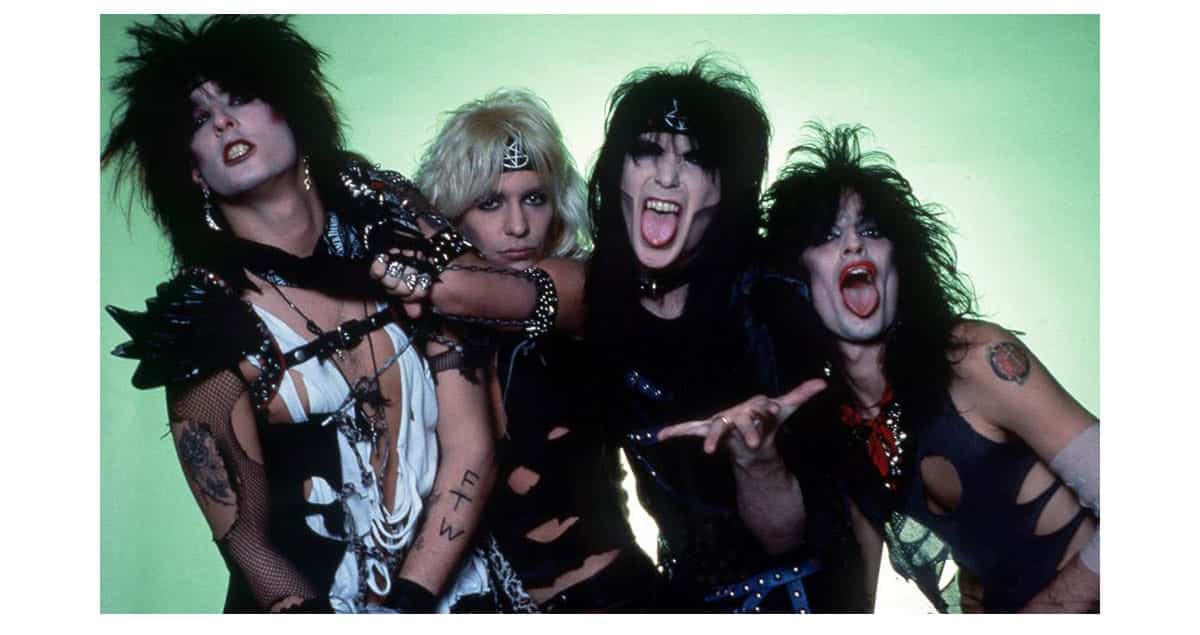
Mötley Crüe: Excess as Weapon, Control as Survival, and the Hard Rock Engine of the Sunset Strip
Mötley Crüe are often reduced to spectacle: makeup, chaos, scandal, and volume. This framing misses the most important truth about the band. Beneath the excess lies a highly controlled hard rock engine—rigid structures, militaristic rhythm choices, and songwriting built for impact rather than nuance. Mötley Crüe did not merely reflect the excess of the 1980s; they weaponized it.
Their significance is not rooted in rebellion for rebellion’s sake. It is rooted in discipline disguised as chaos. Every shout, every stomp, every blunt-force riff was designed to hit immediately and repeatedly. In an era increasingly obsessed with polish and virtuosity, Mötley Crüe doubled down on force, turning hard rock into a blunt instrument that dominated arenas through sheer insistence.
This is not a story of glam. It is a story of hard rock simplified to survive at maximum volume.
The Los Angeles Crucible: Image as Delivery System
The Sunset Strip of the early 1980s was not merely a scene; it was a proving ground. Bands competed not only on musical ability but on visibility, memorability, and intimidation. Mötley Crüe understood this environment better than most.
From the beginning, the band treated image as a delivery system, not an identity. The theatrics were designed to amplify the music’s impact, not replace it. This distinction matters. Unlike bands whose visuals compensated for weak material, Mötley Crüe’s visuals served a hard rock core that was already aggressive and direct.
They stripped hard rock of subtlety and replaced it with immediacy. You did not need to analyze their songs. You needed to feel them—fast, loud, and without negotiation.
Rhythm First: Drums as Command Center
If there is a single structural pillar in Mötley Crüe’s sound, it is the drums. Tommy Lee’s approach redefined how hard rock drums could function in the mainstream.
Rather than swing or groove in the blues tradition, the drumming emphasizes:
Straight, forceful patterns
High-impact fills
Physical presence over finesse
This creates a percussive authority that drives the entire band forward. The drums do not follow the riff; they command it. Guitars lock into the drum patterns, vocals ride above them, and the entire song becomes a forward-moving unit.
This militaristic approach to rhythm is one of the band’s most overlooked contributions to hard rock. It paved the way for later arena metal and hard rock acts that prioritized power and synchronization over feel.
Guitar: Riffs as Blunt Objects
Mötley Crüe’s guitar work is often dismissed as simplistic, but this simplicity is intentional. Mick Mars’ riffs function less as melodies and more as percussive objects.
Key characteristics include:
Repetition over variation
Mid-tempo dominance
Heavy reliance on palm-muted patterns
The riffs are not designed to evolve; they are designed to persist. This persistence creates hypnosis through repetition, a hallmark of effective hard rock when performed at scale.
Solos, when present, are concise and aggressive. They do not explore harmonic depth. They punctuate. This reinforces the band’s philosophy: the song’s momentum matters more than individual expression.
Vocals: Attitude Over Technique
Vince Neil’s vocals embody the band’s commitment to attitude as delivery. Technical precision is secondary to impact and urgency.
The vocal approach emphasizes:
Shouted phrasing
Short melodic bursts
Immediate hooks
Rather than anchoring songs emotionally, the vocals act as another rhythmic element. They punctuate riffs, reinforce choruses, and amplify momentum. This aligns closely with hard rock’s most physical traditions, where vocals are part of the machine rather than a separate layer.
This approach also makes the songs highly adaptable to live performance. Precision is less important than presence, allowing the band to maintain intensity regardless of conditions.
Songwriting: Hard Rock as Infrastructure
Mötley Crüe’s songwriting rejects complexity by design. Songs are built from limited components arranged for maximum durability.
Common traits include:
Clear verse-chorus separation
Immediate entry into core ideas
Minimal bridges or diversions
This infrastructure-oriented songwriting ensures that songs function in large venues. Choruses are designed to be shouted by thousands. Riffs are designed to survive imperfect acoustics. Tempos are chosen to maintain physical engagement.
Hard rock, at this scale, becomes architecture. Mötley Crüe understood that and built accordingly.
Production Choices: Loudness as Identity
Production in Mötley Crüe’s catalog prioritizes impact over depth. The mixes are dense, aggressive, and forward-facing. There is little concern for subtlety or space.
This creates:
A wall-of-sound effect
Consistent loudness across tracks
A sense of relentless pressure
While this approach sacrifices nuance, it gains authority. The songs do not invite careful listening; they demand attention. In the competitive sonic environment of 1980s rock radio, this was not a flaw—it was survival.
Excess as Strategy, Not Accident
The band’s infamous excess is often portrayed as loss of control. In reality, it functioned as branding aligned with their music’s aggression. Chaos became part of the product.
This strategy reinforced:
The band’s unpredictability
Their rejection of refinement
Their opposition to polished professionalism
Yet musically, the band remained remarkably consistent. Even at their most self-destructive, the core hard rock formula stayed intact. This separation between lifestyle chaos and musical discipline is crucial to understanding their longevity.
Live Performance: Hard Rock as Physical Event
Mötley Crüe’s live shows are not interpretations; they are events. The performance philosophy centers on overwhelming the audience rather than engaging them intellectually.
Key elements include:
Volume as immersion
Visual spectacle synchronized with music
Relentless pacing
The goal is not variation but saturation. By the end of a set, the listener is not reflecting—they are exhausted. This aligns perfectly with the band’s conception of hard rock as physical release rather than emotional exploration.
Influence: The Normalization of Aggression
Mötley Crüe’s true influence lies in normalization. They made aggressive, stripped-down hard rock acceptable at the highest commercial levels.
Their legacy can be traced through:
Later glam-metal acts adopting heavier rhythms
Arena rock bands emphasizing spectacle and force
Modern hard rock acts prioritizing immediacy over complexity
They proved that hard rock could thrive without refinement, without intellectual framing, and without apology.
Aging Without Reinvention
Unlike bands that survived by reinventing their sound, Mötley Crüe survived by doubling down. Their refusal to evolve stylistically became a statement in itself.
This consistency allows:
Their catalog to remain immediately recognizable
Live shows to function as controlled recreations
The band’s identity to remain intact despite cultural shifts
Hard rock, in this model, is not about progress. It is about endurance.
Conclusion: Hard Rock Reduced to Force
Mötley Crüe represent hard rock stripped to its most aggressive essentials. Their music is not subtle, not flexible, and not introspective. It is force applied repeatedly until resistance breaks.
In a genre often split between technical mastery and emotional expression, Mötley Crüe chose a third path: domination through insistence. They remind us that hard rock’s power does not always come from skill or sensitivity—but from conviction delivered at maximum volume.
They did not refine hard rock. They hardened it.