
Slipknot: Organized Violence, Rhythmic Terror, and the Industrial Evolution of Hard Rock Aggression
Slipknot are frequently framed as chaos incarnate: masks, noise, fury, and emotional extremity. This surface-level reading overlooks the band’s most defining trait. Slipknot are not chaotic. They are hyper-organized. Their music is not an explosion—it is a controlled detonation, engineered through precision, repetition, and relentless rhythmic enforcement.
While often grouped under nu metal or extreme metal umbrellas, Slipknot’s real significance lies in how they reengineered hard rock’s physical impact for a post-industrial, post-grunge generation. They did not abandon hard rock fundamentals. They weaponized them, scaling aggression until it became overwhelming.
This is not rebellion as expression. This is aggression as system.
The End of Groove, the Rise of Impact
By the late 1990s, heavy music faced a saturation point. Groove metal had slowed things down, alternative metal softened edges, and hard rock risked losing its sense of danger. Slipknot emerged not by rejecting these movements, but by compressing their most violent elements into a single structure.
From the outset, their approach emphasized:
Density over groove
Impact over swing
Synchronization over freedom
Where classic hard rock relied on blues-derived motion, Slipknot replaced feel with force. Songs do not roll; they collide. The objective is not momentum, but shock—repeated until it becomes normalized.
This marked a crucial shift: heaviness no longer depended on tempo or complexity, but on percussive saturation.
Percussion as Architecture
Slipknot’s defining innovation lies in their expanded rhythm section. Multiple percussionists are not a gimmick; they are structural.
The band treats rhythm as:
A layered weapon
A source of intimidation
The primary melodic force
Traditional hard rock positions drums as support. Slipknot reverse this hierarchy. Guitars respond to percussion rather than lead it. Riffs exist to reinforce rhythmic violence, not to define harmony.
This percussive architecture creates a constant sense of threat. Even when tempos drop, pressure remains high. Silence is rare. Space is eliminated. The listener is enclosed.
This approach redefines hard rock’s physicality. It is no longer about movement—it is about containment.
Guitars: Texture Over Identity
Slipknot’s guitar work rejects the classic hard rock notion of riff identity. Instead, guitars function as textural reinforcements, thickening the rhythmic assault rather than defining it.
Key characteristics include:
Down-tuned repetition
Minimal melodic development
Riffs designed to loop aggressively
There is no heroism here. Solos are rare, brief, and intentionally disruptive rather than expressive. This strips guitars of individual identity and converts them into mechanical components.
This philosophy aligns more closely with industrial design than traditional metal virtuosity. Guitars become part of a system rather than a voice.
Vocals as Psychological Pressure
Corey Taylor’s vocal approach is central to Slipknot’s dominance. His performance is not about range; it is about pressure modulation.
Rather than maintaining a single extreme, he alternates between:
Percussive screaming
Rhythmic barking
Sudden melodic release
These shifts are not emotional catharsis—they are tactical. They destabilize the listener, preventing acclimation. Just as one mode becomes familiar, it is replaced.
This vocal strategy transforms the human voice into another percussive element, reinforcing the band’s overarching rhythm-first philosophy.
Songwriting: Cycles of Punishment
Slipknot songs are rarely linear journeys. They are cycles. Themes repeat, riffs return, rhythms reassert dominance.
This cyclical structure creates:
Psychological fatigue
A sense of inescapability
Reinforced identity through repetition
Traditional hard rock builds tension toward release. Slipknot often deny release entirely. When it arrives, it is brief and immediately withdrawn.
This denial is crucial. It positions the listener not as participant, but as subject. The music does not invite; it imposes.
Production: Compression as Ideology
Slipknot’s production choices emphasize compression, density, and forward pressure. Dynamic range is sacrificed in favor of constant intensity.
This creates:
Uniform loudness
Minimal breathing room
A claustrophobic sonic environment
Rather than allowing instruments to occupy distinct spaces, the mix forces them into collision. This reinforces the band’s core aesthetic: no escape, no distance, no relief.
From a hard rock perspective, this represents an ideological shift. Production becomes a weapon, not a frame.
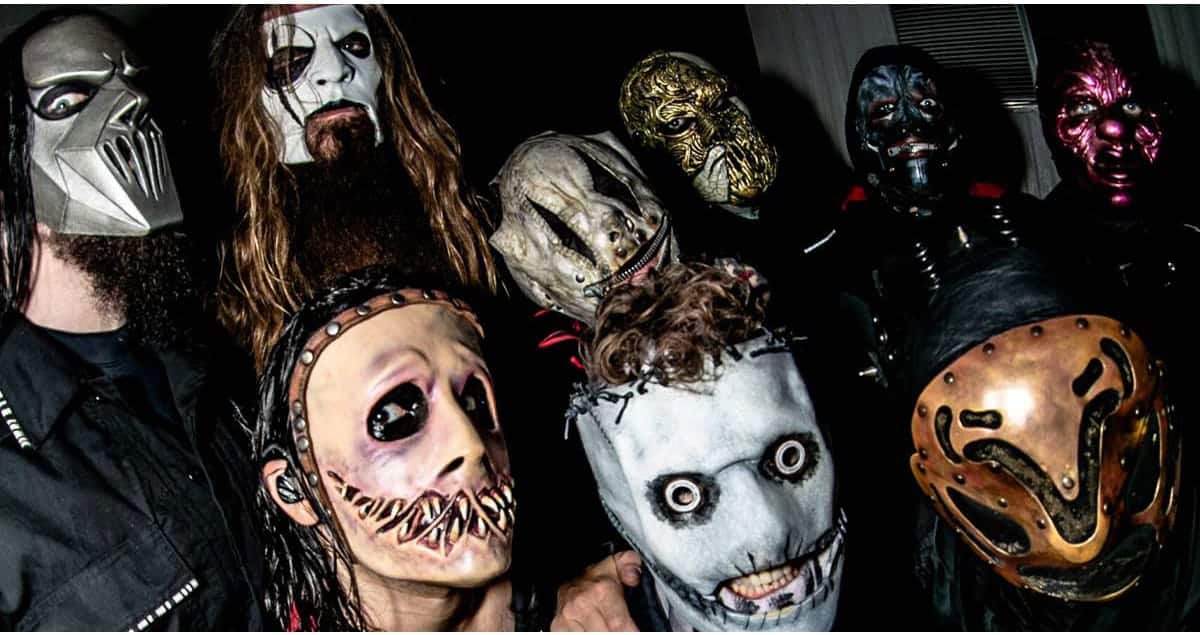
Image as Psychological Reinforcement
The masks and visual identity are often misunderstood as shock tactics. In reality, they reinforce the music’s dehumanization.
By obscuring individuality:
Ego is minimized
Collective identity is amplified
The band becomes an entity rather than individuals
This mirrors the music’s structure. Just as instruments lose individual prominence, faces disappear. The result is a unified threat.
Hard rock has always flirted with danger. Slipknot removed the flirtation.
Live Performance: Total Sensory Assault
Slipknot’s live shows are not concerts; they are environments. The objective is immersion through overload.
Key elements include:
Relentless pacing
Maximum volume
Visual aggression synchronized with rhythm
There is no narrative arc. There is endurance. The audience is tested, not entertained. This aligns perfectly with the band’s philosophy of music as confrontation.
Influence: Redefining Acceptable Aggression
Slipknot normalized levels of aggression previously considered underground-only. They proved that extreme intensity could exist at the mainstream level without dilution.
Their influence can be seen in:
Modern hard rock embracing harsher textures
Metal bands prioritizing rhythm over melody
Live production favoring impact over nuance
They shifted the center of gravity. After Slipknot, heaviness had a new baseline.
Aging Without Softening
Unlike many extreme bands, Slipknot did not mellow with age. While textures evolved, the core philosophy remained intact.
This consistency ensures:
Identity stability
Generational relevance
A catalog that functions as a single, cohesive statement
Hard rock and metal often struggle with aging. Slipknot avoided this by anchoring their sound in systematic aggression, not youth-driven rebellion.
Conclusion: Hard Rock Beyond Catharsis
Slipknot represent the moment when hard rock crossed from expression into enforcement. Their music does not seek understanding or release. It seeks submission through repetition and force.
They did not evolve hard rock melodically or harmonically. They redefined its physical threshold. In doing so, they created a model of heaviness that remains unmatched in its discipline and intensity.
Slipknot are not chaos.
They are organized violence—and that organization is their greatest strength.