
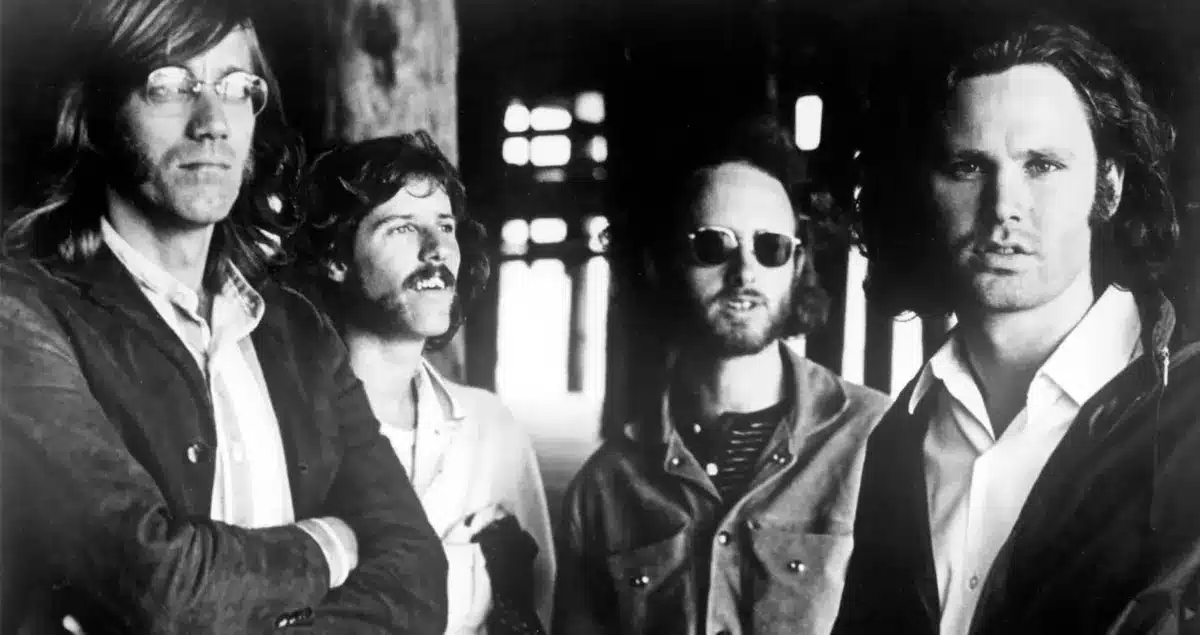
The Doors: Minimal Line-Up, Hypnotic Repetition, and the Dark Architecture of American Rock
The Doors are often described in mystical language—psychedelic, poetic, mysterious. These adjectives obscure a more important reality. At their core, The Doors were a study in structural minimalism and psychological pressure. Their music is not expansive in the traditional sense. It is contained, repetitive, and methodical.
Unlike many late-1960s rock bands that embraced layered production and instrumental excess, The Doors operated with a lean configuration. No traditional bass player in their early years. Limited overdubs. Songs built from recurring patterns rather than elaborate arrangements. This reduction created space—but not comfort. The space is tense, deliberate, and charged.
The Doors did not overwhelm with density. They dominated through control and repetition.
The Power of the Four-Piece Without a Bassist
One of the band’s defining structural decisions was functioning largely without a dedicated live bass player. Instead, keyboard bass lines filled the low end. This unconventional approach shaped their identity in critical ways.
The absence of a traditional bass guitarist resulted in:
Clearer separation between rhythm and melody
Emphasis on organ-driven harmonic structure
Leaner, more exposed arrangements
Rather than creating emptiness, this structure created tension. With fewer layers to hide behind, every instrument had to justify its presence. The result is music that feels skeletal yet heavy.
This skeletal heaviness distinguishes The Doors from many of their psychedelic contemporaries. They do not rely on studio swirl or sonic saturation. They rely on pattern reinforcement.
Keyboard as Structural Spine
Ray Manzarek’s keyboard work forms the architectural foundation of The Doors’ sound. The organ does not embellish—it defines.
Characteristics of this approach include:
Repeating arpeggiated figures
Locked rhythmic pulses
Limited harmonic deviation
Instead of evolving chord progressions continuously, songs often hinge on a few repeating harmonic centers. This repetition builds hypnotic pressure. The listener is drawn into a loop that intensifies through persistence rather than complexity.
In hard rock lineage, repetition often reinforces riff identity. The Doors achieve similar reinforcement through keyboard-driven patterns. The organ becomes the equivalent of a distorted rhythm guitar—anchoring and unyielding.
Guitar: Texture Over Dominance
Robby Krieger’s guitar work differs from the blues-heavy dominance typical of late-1960s rock. His playing emphasizes texture and strategic placement rather than constant riff assertion.
Key elements include:
Sparse chordal punctuation
Modal leads rather than blues clichés
Integration with keyboard harmony
The guitar rarely overwhelms the arrangement. It enters deliberately, often enhancing tension rather than releasing it. Solos are controlled and purposeful, avoiding flamboyance.
This restraint reinforces the band’s minimal aesthetic. The guitar is a component, not the centerpiece. Authority emerges from alignment, not virtuosity.
Drums: Hypnotic Stability
The Doors’ rhythmic identity depends heavily on consistency. Drumming prioritizes steady patterns over dynamic variation.
Common traits:
Repetitive mid-tempo grooves
Limited fills
Emphasis on maintaining trance-like pacing
This steady pulse prevents songs from drifting into improvisational looseness. Even extended tracks remain structurally grounded. Momentum is sustained through predictability rather than acceleration.
Such discipline places The Doors closer to hard rock’s structural traditions than their psychedelic label suggests.
Vocals: Command Through Intensity
Jim Morrison’s vocal presence often dominates discussion, but the mechanics behind that presence are structural rather than purely theatrical.
His delivery relies on:
Controlled baritone projection
Rhythmic phrasing aligned with instrumental repetition
Minimal melodic ornamentation
Rather than floating melodically above the instrumentation, Morrison’s voice often mirrors rhythmic patterns. This creates cohesion. The voice becomes another reinforcing element in the structure.
When intensity rises, it does so within the established framework. There is escalation, but not collapse. The tension remains contained.
Song Architecture: Expansion Without Fragmentation
The Doors frequently extended song lengths, yet they avoided fragmentation. Even longer compositions maintain identifiable centers.
Structural characteristics include:
Recurrent instrumental motifs
Gradual layering of dynamics
Controlled climactic peaks
Improvisation appears, but it remains tethered to core patterns. The architecture does not dissolve. Instead, it stretches.
This ability to extend without disintegrating distinguishes them from looser psychedelic acts. The Doors treat expansion as magnification, not transformation.
Production: Atmosphere Through Restraint
The band’s production style avoids excessive ornamentation. Reverb is present but not overwhelming. Instrument separation remains clear.
This results in:
Intimate but tense sonic space
Clear articulation of repeating motifs
Focus on live-feel authenticity
Unlike heavily layered studio productions of the era, The Doors’ recordings often feel immediate. There is atmosphere, but it arises from arrangement rather than studio effects.
Restraint enhances durability. Without excessive production trends anchoring them to a specific era, the recordings retain structural clarity.
Lyrical Perspective: Confrontation Rather Than Escape
The Doors’ lyrical themes often explore psychological tension, alienation, and existential unease. Importantly, these themes are delivered without sentimentality.
The lyrics:
Avoid overt moral framing
Embrace ambiguity
Reinforce repetition through mantra-like phrasing
This approach strengthens the band’s hypnotic identity. Words echo over recurring patterns, amplifying tension rather than resolving it.
In classic rock lineage, this detached intensity parallels hard rock acts that prioritize atmosphere over narrative resolution.
Live Performance: Controlled Unpredictability
Live, The Doors balanced structure with volatility. Extended instrumental passages and spoken-word sections created unpredictability, yet the underlying framework remained intact.
Key traits include:
Repetition anchoring improvisation
Consistent rhythmic centers
Escalation contained within pattern
Even when performances veered toward chaos, the musical structure acted as a stabilizing force. The tension between order and unpredictability became a defining trait.
Influence: The Blueprint for Dark Minimalism
The Doors’ influence extends beyond psychedelic categorization. They established a template for bands seeking power without density.
Their impact can be traced through:
Post-punk’s emphasis on repetition
Gothic rock’s atmospheric minimalism
Alternative rock’s integration of keyboard-driven structures
The idea that minimal instrumentation can produce maximum psychological impact owes much to their model.
Longevity Through Structural Clarity
Because The Doors built their sound on repetition and disciplined arrangement rather than trend-driven production, their music maintains relevance. The absence of excessive layering allows the core architecture to remain visible decades later.
Their catalog demonstrates:
Consistency of approach
Defined instrumental roles
Clear sonic identity
Hard rock durability often depends on clarity of structure. The Doors exemplify this principle.
Conclusion: Hypnosis as Authority
The Doors were not merely a psychedelic band orbiting counterculture symbolism. They were architects of controlled tension. Through repetition, minimal instrumentation, and rhythmic discipline, they created music that feels both sparse and heavy.
Their power lies not in excess but in containment. They demonstrate that authority in rock music can emerge from reduction rather than expansion.
They did not flood the listener with sound.
They locked them into a pattern—and tightened it until escape felt impossible.