

The Rolling Stones: Longevity, Rebellion, and the Architecture of Rock
Quick Facts
Founded: 1962
Origin: London, England
Genres: Rock, Blues Rock, Hard Rock
Classic Line-Up: Mick Jagger, Keith Richards, Charlie Watts, Ronnie Wood (earlier: Brian Jones, Bill Wyman)
Years Active: 1962–present
Origin Story – Blues Obsession Becomes a Band
The Rolling Stones began with a shared obsession: American blues.
Mick Jagger and Keith Richards reconnected as teenagers when they discovered a mutual interest in artists like Muddy Waters and Chuck Berry. Unlike many British bands of the early 1960s, their focus was not pop harmonies but raw rhythm and blues.
Brian Jones played a key role in organizing the early version of the band. He recruited musicians, secured gigs, and helped define their early identity. The group performed regularly in London clubs, building a reputation for energy and edge.
Manager Andrew Loog Oldham quickly recognized their potential. He positioned them as the opposite of The Beatles — less polished, more rebellious, more confrontational.
That image became a strategic advantage.
The Turning Point – From Covers to Songwriters
In their early years, The Rolling Stones relied heavily on blues covers. While technically strong, they lacked an original songwriting voice.
Under pressure from management, Jagger and Richards began writing together. What started as necessity evolved into one of rock’s most productive partnerships.
By the mid-1960s, songs like “(I Can’t Get No) Satisfaction” signaled a breakthrough. The riff was simple but direct. The lyrics reflected frustration and cultural tension.
The band transitioned from interpreters of American blues to creators of a distinctly British rock identity.
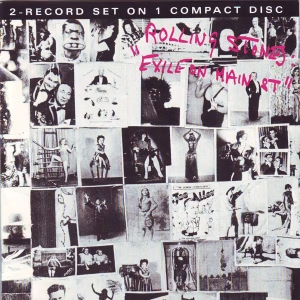
Milestone Album – Exile on Main St. (1972)
Released in 1972, Exile on Main St. is widely regarded as the band’s artistic peak.
Recorded in France under fragmented and informal conditions, the album captures a loose but cohesive sound. It blends rock, blues, gospel, country, and soul influences.
Unlike more polished studio productions of the era, Exile feels dense and layered. The mix prioritizes groove over clarity. Vocals often blend into the instrumentation rather than dominate it.
Tracks such as “Tumbling Dice” and “Rocks Off” demonstrate the band’s ability to maintain rhythmic control while sounding unstructured.
This album cemented their reputation not just as hitmakers but as album-oriented artists.
Signature Song – (I Can’t Get No) Satisfaction
“Satisfaction” remains one of the defining songs of 1960s rock.
The central riff, written by Keith Richards, is minimal but immediately identifiable. The distorted tone was initially intended as a placeholder for horns, but it became the track’s defining feature.
Lyrically, the song addresses consumer frustration and cultural dissatisfaction. Its directness resonated widely, especially with younger audiences.
The song established The Rolling Stones as leaders of a more aggressive strain of rock.
Internal Change – Brian Jones to Ronnie Wood
Brian Jones’ role diminished as Jagger and Richards took creative control. His struggles with substance abuse and internal conflict led to his departure in 1969. He died shortly after.
Mick Taylor replaced Jones during a musically expansive period, contributing to albums like Sticky Fingers and Exile on Main St. His technical precision added depth to the band’s guitar interplay.
In 1975, Ronnie Wood joined, forming the long-term guitar partnership with Richards that continues today.
Unlike many bands of their era, The Rolling Stones adapted to personnel changes without losing structural identity.
Members (Core Era)
Mick Jagger – Vocals
Keith Richards – Guitar
Charlie Watts – Drums
Ronnie Wood – Guitar
Bill Wyman – Bass (until 1993)
Brian Jones – Founder (1962–1969)
Charlie Watts’ steady drumming became one of the band’s most stabilizing elements until his death in 2021.
Selected Studio Discography Highlights
The Rolling Stones (1964)
Aftermath (1966)
Beggars Banquet (1968)
Let It Bleed (1969)
Sticky Fingers (1971)
Exile on Main St. (1972)
Some Girls (1978)
Tattoo You (1981)
Structural Contribution to Rock
The Rolling Stones influenced rock in several measurable ways:
Rebellion as Branding
Their cultivated image of defiance became a template for future rock acts.Riff-Based Songwriting
Keith Richards’ open tuning and rhythmic emphasis shaped hard rock guitar style.Longevity Model
They demonstrated that a rock band could sustain relevance across decades.Live Performance Economy
Stadium touring as a business model was refined through their large-scale productions.
Unlike progressive rock bands, The Rolling Stones did not prioritize complexity. Their strength lay in rhythmic consistency, blues authenticity, and stage presence.
Legacy
The Rolling Stones represent continuity in rock music.
They survived cultural shifts from the 1960s counterculture through punk, new wave, and modern pop eras. While their sound evolved incrementally, their core structure remained stable: vocal presence, dual guitars, groove-centered rhythm.
They did not invent blues rock. They adapted it, commercialized it, and extended its lifespan.
Their influence is embedded less in innovation and more in durability.
They remain one of rock’s longest-running institutions.