
Deep Purple: The Bridge Between Hard Rock and Heavy Metal
Quick Facts
Founded: 1968
Origin: Hertford, England
Genres: Hard Rock, Heavy Metal, Progressive Rock
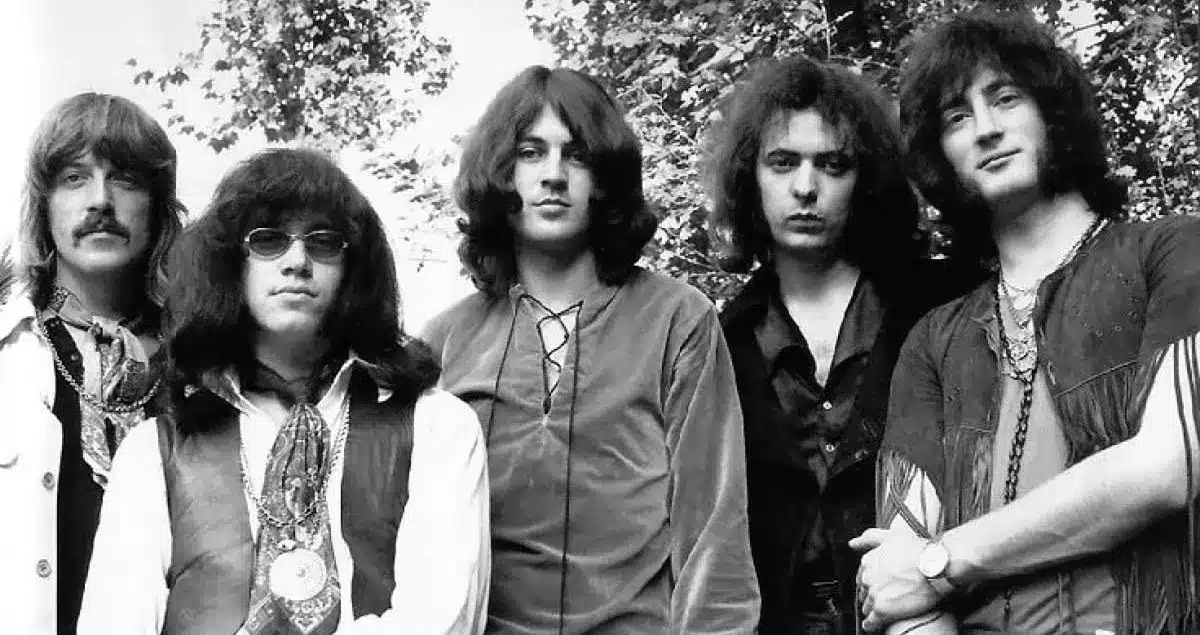
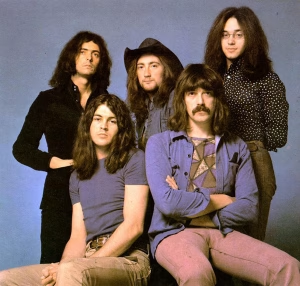
Classic Line-Up (Mark II): Ian Gillan, Ritchie Blackmore, Roger Glover, Jon Lord, Ian Paice
Years Active: 1968–present
Origin Story – Experimentation Before Identity
Deep Purple was formed in 1968 by guitarist Ritchie Blackmore, keyboardist Jon Lord, drummer Ian Paice, bassist Nick Simper, and vocalist Rod Evans. The early version of the band — later referred to as the Mark I line-up — was built around a mix of psychedelic rock and progressive ambitions.
Unlike many British rock bands of the era, Deep Purple incorporated classical influences from the beginning. Jon Lord, trained in classical piano, pushed for orchestral arrangements and structural complexity. This approach led to Concerto for Group and Orchestra (1969), a performance with the Royal Philharmonic Orchestra.
The experiment demonstrated ambition but also revealed tension. Blackmore favored a heavier, riff-driven direction. Lord was interested in symphonic expansion. The internal creative divide would define the band’s evolution.
By 1969, Evans and Simper were replaced by Ian Gillan and Roger Glover.
This shift created what is widely considered the band’s definitive line-up: Mark II.
The Turning Point – A Heavier Identity
With Gillan’s powerful vocal range and Glover’s tighter bass work, Deep Purple moved decisively toward a harder sound.
The 1970 album In Rock marked the transformation.
The production was louder. The guitar tone more aggressive. Jon Lord’s Hammond organ, heavily distorted, became a second lead instrument rather than background texture.
Tracks like “Speed King” and “Child in Time” demonstrated both speed and structural ambition. “Child in Time” in particular showcased dynamic control — quiet organ passages building into extended, high-register vocal peaks.
The album established Deep Purple as part of the emerging heavy rock movement alongside Led Zeppelin and Black Sabbath.
But their defining moment would come soon after.
Milestone Album – Machine Head (1972)
Released in 1972, Machine Head became Deep Purple’s most commercially successful and culturally influential album.
The record was famously recorded in Montreux, Switzerland, after a fire destroyed the intended recording venue — an event later immortalized in one of their songs.
The album includes:
“Highway Star”
“Smoke on the Water”
“Lazy”
“Space Truckin’”
Musically, Machine Head refined their formula:
Tight riff structures
Prominent Hammond organ-guitar interplay
Strong rhythmic foundation from Ian Paice
Clear melodic hooks
The production emphasized clarity without sacrificing weight. The balance between Blackmore’s guitar and Lord’s organ defined the band’s signature sound.
This album positioned Deep Purple as one of the central architects of hard rock.
Signature Song – Smoke on the Water
“Smoke on the Water” is built around one of the most recognizable riffs in rock history.
The riff is structurally simple, based on parallel fourths, making it accessible to beginner guitarists while remaining sonically effective.
Lyrically, the song recounts the real-life fire at the Montreux Casino during a Frank Zappa concert. Rather than abstract themes, the narrative is literal and documentary.
Its impact lies in economy:
Minimal chord movement
Clear rhythmic phrasing
Memorable hook
The track became a gateway song for aspiring guitarists and a permanent fixture in rock culture.
Line-Up Changes and Instability
Deep Purple’s history is marked by frequent personnel shifts. The Mark II line-up dissolved in 1973 when Ian Gillan and Roger Glover departed.
Subsequent versions of the band — Mark III and Mark IV — introduced David Coverdale, Glenn Hughes, and later Tommy Bolin. These eras incorporated funk and blues elements but struggled with internal tension.
By 1976, the band disbanded.
They reunited in 1984 with the classic Mark II line-up, releasing Perfect Strangers. The reunion proved commercially successful, reaffirming their legacy.
However, further internal conflicts led to Ritchie Blackmore’s final departure in 1993. Steve Morse later assumed guitar duties, and the band continued touring and recording into the 21st century.
Deep Purple became less defined by a single era and more by adaptability.
Members (Mark II – Classic Era)
Ian Gillan – Vocals
Ritchie Blackmore – Guitar
Roger Glover – Bass
Jon Lord – Keyboards
Ian Paice – Drums
Ian Paice remains the only constant member across all line-ups.
Core Studio Discography (Selected Highlights)
Shades of Deep Purple (1968)
Deep Purple in Rock (1970)
Fireball (1971)
Machine Head (1972)
Who Do We Think We Are (1973)
Burn (1974)
Stormbringer (1974)
Perfect Strangers (1984)
Structural Contribution to Rock
Deep Purple’s significance lies in three core areas:
Organ-Guitar Dual Lead Structure
The Hammond organ functioned as a co-lead instrument, expanding harmonic density.Technical Precision in Hard Rock
Their interplay required high-level musicianship, particularly in live improvisations.Bridge Between Hard Rock and Metal
While not as dark as Black Sabbath, they contributed speed and technicality that influenced later metal bands.
Bands in the New Wave of British Heavy Metal cited Deep Purple as foundational, particularly for vocal intensity and instrumental interplay.
Legacy
Deep Purple helped formalize the sound of 1970s hard rock. Their influence can be traced in heavy metal, progressive rock, and arena rock traditions.
They were not defined by mysticism or theatricality. Instead, their impact came from structural clarity:
Strong riffs
Instrumental precision
Dynamic contrast
While other bands leaned into myth or darkness, Deep Purple focused on musicianship and momentum.
Their role in rock history is not peripheral.
They were one of the pillars.